If you have ever studied Korean, you probably noticed how lively and expressive it sounds. One big reason is the rich use of onomatopoeia. These are words that imitate sounds, feelings, or movements. But in Korean, they go far beyond simple sound effects. They describe textures, emotions, speed, atmosphere, and even personality.
When you compare them to English, you quickly realize that Korean onomatopoeia often feels more vivid and detailed. Instead of using a full sentence, you can use one word to paint a clear picture in someone’s mind.
In this guide, you will discover ten Korean onomatopoeia words that are more expressive than their English equivalents. You will also learn how to use them naturally so your Korean sounds more fluent and engaging.
Quick Summary Table 📊
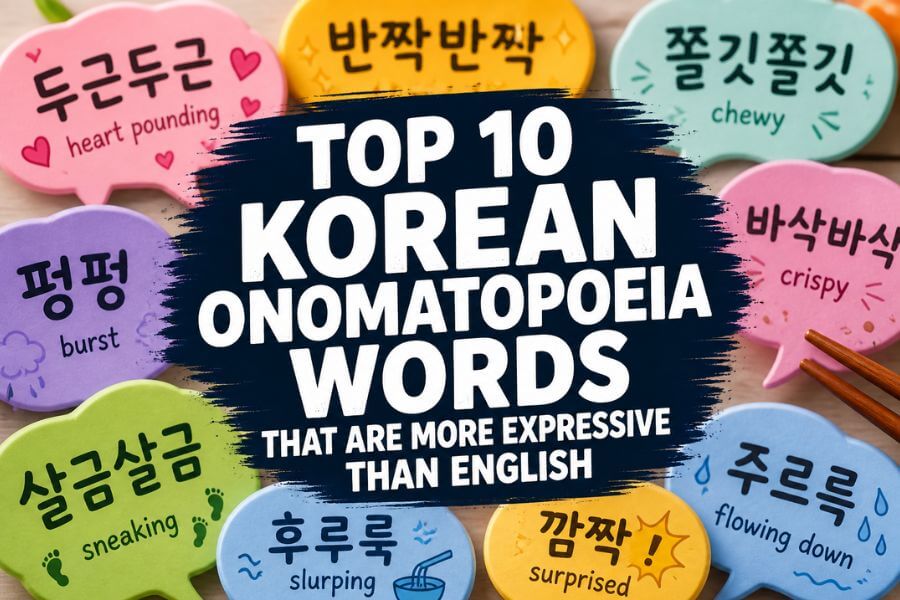
| No. | Korean Word | Pronunciation | Basic Meaning | Why It Stands Out |
|---|---|---|---|---|
| 1 | 두근두근 | du-geun du-geun | Heart pounding | Captures emotion and rhythm |
| 2 | 반짝반짝 | ban-jjak ban-jjak | Sparkling | Adds visual brightness |
| 3 | 살금살금 | sal-geum sal-geum | Sneaking quietly | Shows careful movement |
| 4 | 쫄깃쫄깃 | jjol-git jjol-git | Chewy texture | Describes food feel precisely |
| 5 | 바삭바삭 | ba-sak ba-sak | Crispy | Sound plus texture combined |
| 6 | 후루룩 | hu-ru-ruk | Slurping | Action and sound together |
| 7 | 펑펑 | peong peong | Burst or heavy fall | Strong intensity |
| 8 | 어슬렁어슬렁 | eo-seul-leong eo-seul-leong | Loitering | Relaxed, slow movement |
| 9 | 깜짝 | kkam-jjak | Suddenly surprised | Instant emotional reaction |
| 10 | 주르륵 | ju-reu-reuk | Flowing down | Smooth continuous motion |
How We Ranked These 🔍
To give you the most useful and interesting list, these words were selected based on the following key factors:
- Expressiveness compared to English equivalents
- Frequency in everyday Korean conversations
- Ability to describe both sound and feeling at once
- Cultural relevance in Korean media and daily life
- Ease of use for learners
- Versatility across different situations
- Emotional impact and imagery
1. 두근두근 (du-geun du-geun) ❤️
This word describes the sound and feeling of a pounding heart. In English, you might say “my heart is beating fast,” but Korean condenses that into one vivid expression.
You can use 두근두근 when you are nervous, excited, or in love. It reflects both the physical sensation and the emotional state at the same time.
For example, when you are about to meet someone special, you can say your heart is going 두근두근. It feels more alive than simply saying “I am nervous.”
What makes this word powerful is its rhythm. The repetition mimics the heartbeat itself, making it feel natural and immersive.
2. 반짝반짝 (ban-jjak ban-jjak) ✨
This word means sparkling or twinkling. In English, you might say “shiny” or “sparkly,” but 반짝반짝 gives a stronger visual image.
It is often used to describe stars, clean surfaces, or even someone’s bright eyes. The repetition adds a sense of continuous light and movement.
For example, instead of saying “the stars are bright,” you can say they are 반짝반짝, which feels more magical and lively.
This word is especially common in songs and children’s stories, which shows how deeply it connects to imagination.
3. 살금살금 (sal-geum sal-geum) 🐾
This word describes moving quietly and carefully, like sneaking. English has phrases like “tiptoeing,” but 살금살금 feels softer and more detailed.
It suggests slow, cautious movement, often with a sense of secrecy. You might use it when someone is trying not to wake others.
For example, a child sneaking into the kitchen at night would move 살금살금.
The repetition makes the movement feel ongoing and gentle, which English often struggles to capture in one word.
4. 쫄깃쫄깃 (jjol-git jjol-git) 🍡
This word describes a chewy and slightly bouncy texture. English words like “chewy” are simple, but 쫄깃쫄깃 adds a sensory experience.
It is commonly used for foods like rice cakes or noodles. When you hear it, you can almost feel the texture in your mouth.
For example, Korean rice cakes are often described as 쫄깃쫄깃, which makes them sound more appealing.
This is one area where Korean truly shines, as it has many detailed words for food textures that English lacks.
5. 바삭바삭 (ba-sak ba-sak) 🥨
This word describes something crispy. While English uses “crispy” or “crunchy,” 바삭바삭 includes both the sound and the feeling.
You might use it for fried chicken, chips, or toasted bread. The repetition makes it feel like multiple crunches are happening.
For example, freshly fried chicken skin is perfectly described as 바삭바삭.
It adds excitement and sensory detail, making food descriptions much more vivid.
6. 후루룩 (hu-ru-ruk) 🍜
This word represents the sound and action of slurping noodles. English might say “slurp,” but 후루룩 feels smoother and more fluid.
It captures the quick motion and sound together. In Korean culture, slurping noodles is normal and even enjoyable, so this word appears often.
For example, when eating ramen, you might describe the action as 후루룩.
It gives a lively and realistic image that goes beyond a simple verb.
7. 펑펑 (peong peong) 💥
This word describes something bursting or falling heavily. It can be used for explosions, tears, or even heavy snowfall.
English might need multiple words like “burst loudly” or “fall heavily,” but 펑펑 does it in one.
For example, when someone cries a lot, you can say they cried 펑펑.
The repetition adds intensity, making the action feel stronger and more dramatic.
8. 어슬렁어슬렁 (eo-seul-leong eo-seul-leong) 🚶
This word describes wandering around without purpose. English might say “loitering” or “walking aimlessly,” but this Korean word feels more relaxed.
It often has a slightly lazy or casual tone. You might use it for someone strolling around slowly.
For example, if you walk around a park with no plan, you are moving 어슬렁어슬렁.
The sound of the word itself feels slow and stretched, matching the movement perfectly.
9. 깜짝 (kkam-jjak) 😲
This word describes a sudden surprise. English uses “suddenly” or “startled,” but 깜짝 feels more immediate.
It is often used with verbs to show a quick reaction. For example, you might say you were 깜짝 놀랐다, meaning you were suddenly shocked.
This word captures the exact moment of surprise, not just the feeling after.
It is short, sharp, and very expressive.
10. 주르륵 (ju-reu-reuk) 🌧️
This word describes something flowing down smoothly, like tears, rain, or liquid.
English might say “flowing” or “running down,” but 주르륵 gives a continuous, natural motion.
For example, tears falling down your face can be described as 주르륵.
The sound of the word itself feels like something sliding downward, which makes it highly visual.
Conclusion 🎯
Korean onomatopoeia is one of the most exciting parts of the language. It allows you to express emotions, actions, and sensory details in a way that feels natural and vivid.
As you have seen, many Korean words combine sound, feeling, and movement into a single expression. This is why they often feel more powerful than English equivalents.
If you want to improve your Korean, learning these words is a great step. They will make your speech more natural, your writing more engaging, and your understanding of Korean culture much deeper.
Start using them in simple sentences, and you will quickly notice how much more expressive your Korean becomes.
Frequently Asked Questions ❓
What is the difference between Korean onomatopoeia and English onomatopoeia?
Korean onomatopoeia often includes both sound and feeling, while English mainly focuses on sound. Korean also uses repetition more frequently to add rhythm and intensity.
Why does Korean have so many onomatopoeic words?
Korean language and culture place a strong value on sensory expression. This leads to a wide range of words that describe subtle differences in sound, texture, and emotion.
Are these words used in formal situations?
Most onomatopoeia words are casual, but some can be used in writing, storytelling, and even media. You should be careful when using them in very formal settings.
How can I practice using Korean onomatopoeia?
You can start by listening to Korean dramas, songs, and everyday conversations. Try repeating the words and using them in simple sentences.
Do Korean children learn these words early?
Yes, children learn many onomatopoeia words from a young age. They are commonly used in children’s books, songs, and daily speech, which helps them develop expressive language skills.