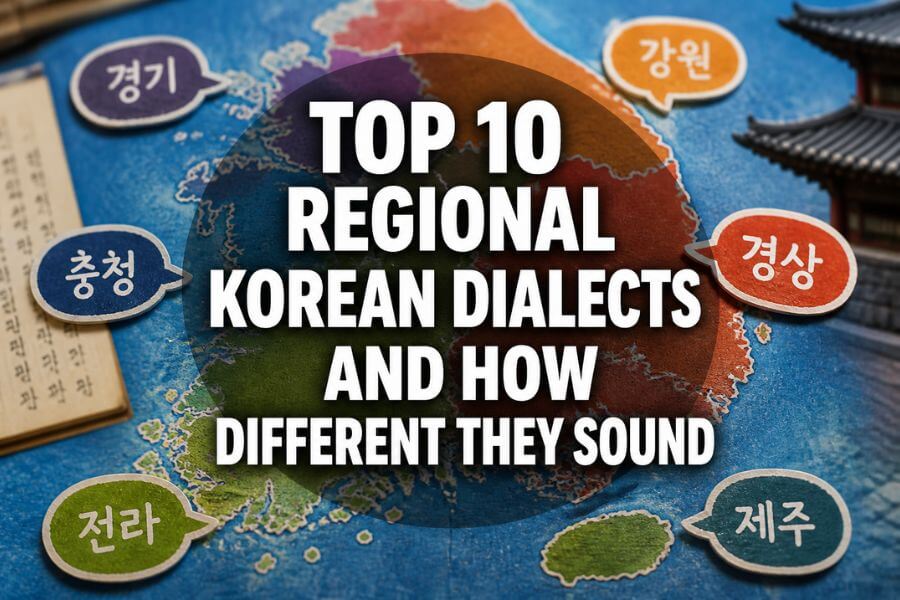
If you have ever studied Korean, you probably started with standard Seoul Korean. It sounds clean, structured, and easy to learn from textbooks. But once you travel across South Korea or watch different local shows, you quickly realize something surprising. Korean can sound completely different depending on where you are.
Regional dialects, known as “satoori,” are a huge part of Korean culture. They are not just accents. They change pronunciation, vocabulary, grammar, and even the emotional tone of speech. Sometimes, two Koreans from different regions may struggle to fully understand each other at first.
In this guide, you will explore the top 10 regional Korean dialects and learn how different they really sound. By the end, you will have a deeper appreciation for the diversity of the Korean language and maybe even pick a favorite dialect.
Quick Summary Table 📊
| Rank | Dialect | Region | Key Sound Traits | Difficulty Level |
|---|---|---|---|---|
| 1 | Gyeongsang Dialect | Busan, Daegu | Strong pitch changes, sharp endings | High |
| 2 | Jeolla Dialect | Gwangju, Jeonju | Softer, musical tone | Medium |
| 3 | Chungcheong Dialect | Daejeon area | Slow, relaxed speech | Low |
| 4 | Gangwon Dialect | Mountain regions | Mixed features, rural tone | Medium |
| 5 | Jeju Dialect | Jeju Island | Almost a separate language | Very High |
| 6 | Hwanghae Dialect | North Korea border | Unique vowel sounds | High |
| 7 | Pyongan Dialect | North Korea | Flat tone, different vocabulary | High |
| 8 | Hamgyong Dialect | Northeast Korea | Harsh consonants | Very High |
| 9 | Seoul Standard | Seoul | Neutral and widely understood | Low |
| 10 | Gyeonggi Dialect | Surrounding Seoul | Slight variation of standard | Very Low |
How We Ranked These 🧠
To give you a clear and helpful list, we used several key factors when ranking these dialects:
- Sound difference from standard Korean
- Ease of understanding for learners
- Unique pronunciation patterns
- Vocabulary differences
- Cultural recognition and popularity
- Real-life usage in media and daily speech
This approach helps you understand not just how different each dialect sounds, but also how practical it is for you to learn or recognize.
1. Gyeongsang Dialect (Busan and Daegu) 🔥
If you want a dialect that stands out immediately, Gyeongsang is the one. Spoken in cities like Busan and Daegu, this dialect is famous for its strong and energetic sound.
What makes it unique is its use of pitch. While standard Korean is not a tonal language, Gyeongsang dialect uses pitch in a way that almost feels like one. A simple sentence can change meaning depending on how you raise or lower your voice.
You will also notice sharper endings. Words often sound shorter and more direct. For example, a polite sentence in Seoul might sound softer, while in Busan it feels more bold and confident.
Because of these features, many learners find this dialect difficult at first. However, it is also one of the most loved dialects in Korean media. Characters who speak it often appear strong, funny, or charismatic.
2. Jeolla Dialect (Southwest Korea) 🎶
Jeolla dialect is often described as warm and musical. If Gyeongsang feels sharp, Jeolla feels smooth.
People from regions like Gwangju and Jeonju tend to stretch their vowels and speak with a gentle rhythm. This creates a softer listening experience that many Koreans associate with kindness and friendliness.
Vocabulary also differs slightly. Some everyday words are unique to this region, which can surprise learners who only know standard Korean.
Even though it sounds pleasant, it can still be tricky to fully understand at first. The rhythm and word choices may slow you down, but once you get used to it, it becomes easier to follow.
3. Chungcheong Dialect (Central Korea) 🐢
If there is one dialect known for being slow and relaxed, it is Chungcheong.
People in this region often speak at a slower pace, sometimes stretching out words. This gives the dialect a laid-back feeling. It almost sounds like the speaker is taking their time with every sentence.
For you as a learner, this can actually be helpful. The slower speed can make it easier to catch individual words. However, the tone may feel unusual if you are used to faster speech.
This dialect is not as dramatically different as others, which is why it ranks lower in difficulty. Still, its rhythm makes it very distinct.
4. Gangwon Dialect (Mountain Regions) 🌄
Gangwon dialect reflects its geography. The region is mountainous and less urban, and the dialect carries a rural tone.
You may notice a mix of features from nearby regions, along with older expressions that are not commonly used in cities. Pronunciation can vary even within the region, making it less consistent.
For you, this means you might hear different variations depending on the specific town. That unpredictability adds to the challenge but also makes it interesting to explore.
5. Jeju Dialect (Jeju Island) 🌊
Jeju dialect is often considered the most unique of all Korean dialects. In fact, many linguists see it as a separate language.
If you hear Jeju speech for the first time, you may not recognize it as Korean at all. The vocabulary is very different, and the pronunciation can feel completely unfamiliar.
Even native Korean speakers from Seoul often struggle to understand it without exposure. This makes it the hardest dialect on this list.
However, it is also one of the most culturally rich. Learning even a few phrases can give you a deeper connection to Jeju’s history and identity.
6. Hwanghae Dialect (Northwest Korea) 🧭
Hwanghae dialect is less widely known but still very distinct. It sits geographically between North and South Korean speech patterns.
You will notice unusual vowel sounds and slight differences in sentence endings. These changes can make familiar words sound new.
For learners, this dialect is challenging mainly because it is not commonly heard in the media. Exposure is limited, which makes it harder to practice.
7. Pyongan Dialect (North Korea) ❄️
Pyongan dialect is commonly associated with North Korea’s capital region. It has a flatter tone compared to South Korean speech.
You may notice less variation in pitch and a more direct speaking style. Vocabulary differences are also significant due to historical separation.
For you, this dialect may feel unfamiliar even if you are comfortable with standard Korean. The differences are not just in sound but also in word choice and expressions.
8. Hamgyong Dialect (Northeast Korea) ⚡
Hamgyong dialect is known for its strong and sometimes harsh sound.
Consonants can feel more intense, and pronunciation may seem rough compared to other dialects. This creates a very distinct listening experience.
Understanding this dialect can be difficult because both sound and vocabulary differ significantly. Like other northern dialects, it is not commonly featured in mainstream media.
9. Seoul Standard Korean 🏙️
Seoul Korean is what you likely learned first. It is considered the standard form of the language.
It is clear, balanced, and widely understood across the country. Most Korean media, education, and official communication use this version.
Because of this, it serves as your foundation. Even when you encounter other dialects, you will often rely on your knowledge of standard Korean to make sense of them.
10. Gyeonggi Dialect (Surrounding Seoul) 🚗
Gyeonggi dialect is very close to Seoul Korean, but with slight differences.
You may hear subtle changes in pronunciation or word choice, but nothing too dramatic. Many people in this region switch easily between standard Korean and their local speech.
For you, this dialect is the easiest to understand. It feels familiar while still offering a small glimpse into regional variation.
Conclusion 🌟
Korean dialects are more than just accents. They reflect history, geography, and culture. As you explore them, you begin to see how rich and diverse the Korean language truly is.
Some dialects may feel challenging at first, especially ones like Jeju or Gyeongsang. But each one gives you a new perspective on how language can change and adapt.
If you are serious about learning Korean, exposing yourself to different dialects will improve your listening skills and cultural understanding. You do not need to master them all, but recognizing their sounds will make you a more confident speaker and listener.
Frequently Asked Questions ❓
What is the hardest Korean dialect to understand?
Jeju dialect is widely considered the hardest. It has a very different vocabulary and pronunciation, and even native Korean speakers often struggle to understand it without prior exposure.
Are Korean dialects mutually understandable?
Most South Korean dialects are somewhat understandable with effort. However, stronger dialects like Gyeongsang or Jeju can be difficult, especially for beginners.
Should you learn a dialect instead of standard Korean?
You should start with standard Korean. It is the most widely used and understood. Once you are comfortable, you can explore dialects to expand your skills.
Do Korean dramas use dialects often?
Yes, many Korean dramas use dialects to show a character’s background. Gyeongsang dialect is especially common in films and TV shows.
Can learning dialects improve your Korean?
Yes, it can improve your listening ability and cultural understanding. It helps you recognize real-life speech patterns beyond textbook Korean.