Landing in South Korea and figuring out how to travel between massive cities can feel intimidating, but the Korea Train Express, known to everyone as the KTX, makes it incredibly simple. This high-speed rail system connects the entire country, whisking you from the historic streets of Seoul to the beautiful southern beaches of Busan in less than three hours. For American travelers used to long road trips or stressful airport security lines, the KTX feels like a breath of fresh air.
This comprehensive guide will walk you through every step of the booking process, from choosing the right website to finding your physical seat on the platform. You do not need to speak Korean or understand complicated transit systems to master this train network. With a little preparation, you can book your rides smoothly and explore South Korea like a seasoned local.
Understanding the KTX High-Speed Network
Before you open a booking page, it helps to understand what the KTX is and how the lines operate across South Korea. Run by the national railway company called Korail, these sleek trains travel at speeds over 180 miles per hour. Instead of spending an entire day driving or dealing with baggage claims at domestic airports, you can cross the entire peninsula in the time it takes to watch a movie.
The KTX operates several major routes that slice through the country. The most famous path is the Gyeongbu Line, which links the capital city of Seoul to the major port city of Busan. Another popular route is the Honam Line, which carries travelers down to the southwestern cultural hubs like Gwangju and Mokpo. There is also the Jeolla Line, which is perfect if you want to visit the famous traditional village in Jeonju or the coastal city of Yeosu.
Knowing your specific route matters because different trains leave from different major hubs inside Seoul. If you are heading to Busan, you will almost always depart from Seoul Station, located right in the center of the city. However, if you are heading down the southwestern side of the country toward Gwangju or Mokpo, your train will likely leave from Yongsan Station, which sits just a few miles south of Seoul Station. Always double-check your departure hub so you do not show up at the wrong station on travel day.
Choosing Between Single Tickets and the Korail Pass
When planning your rail travel, you have two main payment options as an international tourist. You can either buy point-to-point single tickets for each specific ride, or you can purchase a multi-day tourist pass called the Korail Pass, often abbreviated as the KR Pass. The right choice depends entirely on how many cities you plan to visit and how often you will be riding the rails.
Single tickets are the best option if your itinerary is simple. If you are only traveling from Seoul to Busan and then returning to Seoul a few days later, buying two separate single tickets is usually the most practical choice. It gives you a guaranteed seat instantly and involves fewer logistics.
The Korail Pass is a special ticket designed exclusively for foreign tourists, meaning residents and local citizens cannot buy it. This pass allows unlimited rides on KTX trains for a specific number of days. You can choose a consecutive pass, which lasts for three or five days in a row, or a flexible pass, which gives you two or four days of travel to use anytime within a ten-day window. This option is highly cost-effective if you plan to city-hop to multiple destinations, like stopping in Daegu, Gyeongju, and Busan all in one week.
Here is a quick breakdown to help you compare the costs and benefits of each method:
| Ticket Type | Best Suited For | Booking Window | Seat Selection | Cost Advantage |
| Point-to-Point Single Ticket | Travelers visiting only one or two cities with fixed dates | Opens 30 days before departure | Select your precise car and seat during payment | Cheaper for a simple round-trip journey |
| Consecutive Korail Pass | Fast-paced travelers riding long distances every single day | Buy up to a year ahead, reserve seats 30 days out | Limit of two reserved seats per day, unlimited standing | Huge savings if riding three or more long distances |
| Flexible Korail Pass | Spontaneous travelers who want to scatter travel days over a week | Buy up to a year ahead, reserve seats 30 days out | Limit of two reserved seats per day, unlimited standing | Great value for customized, multi-city itineraries |
If you choose the Korail Pass, remember that buying the pass itself does not mean you have a seat reservation yet. The pass simply acts as your payment voucher. Once you buy the pass, you must log back into the system to reserve your specific train times and seat numbers, which you can do online up to one month before your trip.
Step-by-Step Guide to Booking on the Official Korail Website
The most direct way to secure your seats is through the official English website run by Korail. While the interface can sometimes look a little old-fashioned compared to American booking sites, it is the official source and charges no extra service fees.
Step 1: Navigating to the Correct Global Page
Start by searching for the official Korail global booking page. Make sure the website address ends in a dot-com or dot-kr and features the official blue and silver Korail logo. Once the page loads, look at the top right corner to ensure the language is set to English. Do not use the standard Korean page translated through your web browser, as the payment gateways for foreign credit cards are built specifically into the dedicated English version of the site.
Step 2: Entering Your Route and Travel Details
On the main reservation interface, you will see fields for your departure station, arrival station, date, and time. Click on the departure field and type your starting point, such as Seoul. Then, select your destination, like Busan. Choose your travel date from the pop-up calendar. Keep in mind that tickets only go on sale exactly one month before the departure date at 7:00 AM Korea Standard Time. If you try to book six weeks in advance, the calendar will not let you click on your dates. Select your preferred departure hour and enter the number of passengers traveling in your group.
Step 3: Selecting Your Train and Seating Class
Click the search button to generate a list of available trains for that day. The results will display a list of options sorted by departure time. Look closely at the train type column. You want to make sure it says KTX, as slower local trains like the Mugunghwa or ITX also appear on this list. The slower trains are much cheaper but can take five hours to reach Busan instead of the speedy two and a half hours on the KTX.
You will also see columns for First Class and Economy Class, which is sometimes called Standard Class. If a train has open seats, a blue select button will appear. If the seats are completely full, it will display a sold-out message. Click the select button for your preferred time and cabin class.
Step 4: Inputting Personal Information with Precision
After choosing your train, the site will ask for your personal information. Since you are booking as a non-Korean resident, you will fill this out as a guest. You must enter your full name exactly as it appears on your American passport. You will also need to enter your passport number, your email address, and a temporary four-digit password that you create on the spot.
Write down this four-digit password and double-check your email entry for typos. The system does not require you to make a permanent account, so your email address and this temporary password are the only tools you have to retrieve your digital ticket later. If you make a typo in your email, finding your reservation can become a massive headache.
Step 5: Navigating the Foreign Credit Card Payment Gateway
When you reach the checkout page, you will see a section for payment options. Click the option labeled foreign credit card. Do not choose the regular credit card option, as that is coded exclusively for banks located inside South Korea. Enter your card number, expiration date, and security code.
Sometimes, American banks will flag international transactions from South Korea as potential fraud. If your transaction fails on the first try, do not panic. Check your phone for a fraud alert text message from your bank, approve the transaction, and try entering the details on the Korail site one more time. Once the payment clears, a confirmation page will load showing your digital ticket and your exact coach and seat numbers.
Booking via the Korail Talk Mobile App
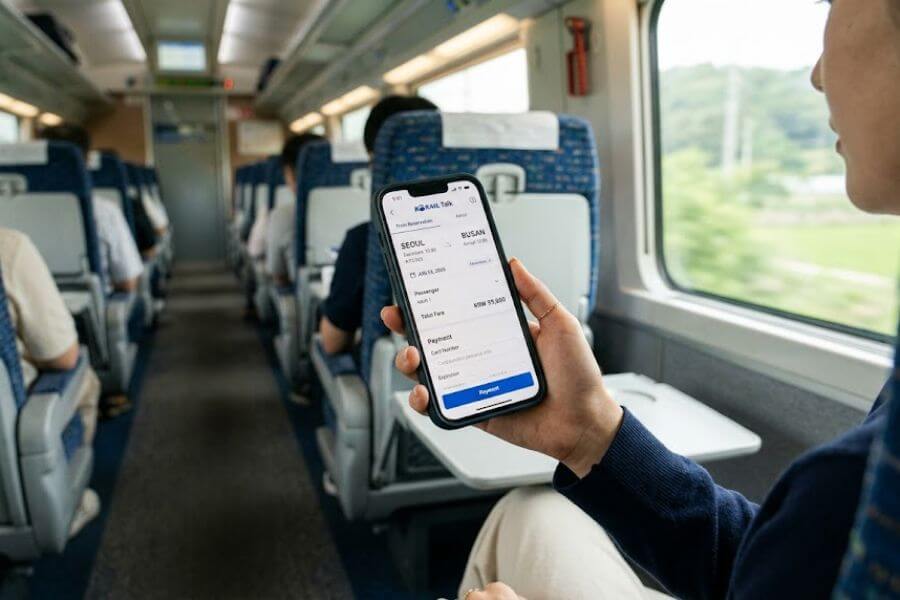
If you prefer managing your travel on a smartphone, you can use the official mobile app called Korail Talk. It is available on both Apple and Android devices and allows you to carry your tickets right on your screen.
Step 1: Downloading and Setting the Language
Search for Korail Talk in your mobile device app store. The icon features a stylized train nose. Download the app and open it. Depending on your phone settings, the app may automatically load in Korean. If this happens, look for a menu button represented by three horizontal lines, or look for a gear icon labeled settings. Look for the language options and select English. The entire layout will shift into an easy-to-read English interface.
Step 2: Setting Up a Guest Profile
Just like the website, the app allows international tourists to book tickets without creating a complicated local account. When prompted to log in, choose the guest or foreigner option. The app will ask for your name, nationality, and passport details. Entering this information ahead of time helps streamline the booking process so you can grab tickets quickly if you are traveling during a busy weekend.
Step 3: Searching and Selecting Your Journey
The app home screen features a clean search interface. Tap on the departure and arrival fields to select your stations. Set your date and time using the scrolling wheels. Tap the search button to see a vertical list of trains. The app uses clear icons to distinguish high-speed KTX trains from slower models. Tap on your preferred time slot, select your desired cabin class, and proceed toward the seat selection map.
Step 4: Utilizing the Interactive Seat Map
One of the best features of the mobile app is the interactive seat map, which lets you pick your exact spot inside the train car. After selecting your cabin class, tap the seat selection button. A graphic representation of the train car will appear.
Seats highlighted in gray are already taken, while open seats appear in white or blue. You can scroll through different train cars to find rows where your travel group can sit together. Pay close attention to the direction arrow on the screen. Some KTX seats face backward during the journey, so if you are prone to motion sickness, make sure to pick a seat where the small arrow points forward in the direction of travel.
Step 5: Completing App Payment and Saving the Ticket
Once you select your seats, click the payment button at the bottom of your screen. Select the international credit card tab, enter your payment details, and complete any security verification required by your bank.
Once successful, your ticket will appear in the my ticket section of the app. It includes a unique barcode and your travel details. You do not need to print this out. As long as the ticket is loaded inside the official app on your phone, you are completely ready to board. Avoid taking screenshots of the ticket, as train conductors require the live app interface during random ticket checks.
Alternative Booking Platforms for Added Simplicity
If the official government website or app feels a bit too clunky, or if your American credit card continues to experience payment errors, you can use authorized third-party booking platforms. Companies like Klook or KKday are fully licensed to sell official KTX tickets to international travelers.
Using a third-party platform offers a few distinct advantages for Americans. First, their payment systems are fully optimized for international commerce, meaning you can pay with American credit cards, Apple Pay, or PayPal without experiencing any security freezes or local gateway errors. Second, these platforms display prices directly in US dollars, so you do not have to calculate currency conversions on the fly.
The process on these platforms is very straightforward. You enter your travel cities and dates into their search engine, pick your train time, and enter your passenger details. Once you pay, the platform issues an official electronic voucher or digital ticket via email.
The minor downside to using these alternative platforms is that they sometimes charge a small booking fee, or they may not allow you to pick your exact seat number from a live map, instead assigning you the best available seats automatically. However, for travelers who want a stress-free checkout experience without dealing with local Korean banking security pop-ups, these platforms are a wonderful alternative.
Selecting the Right Cabin Class
When purchasing your KTX ticket, you will have to choose between First Class and Economy Class. Both options provide a comfortable ride, but understanding what each cabin offers can help you decide if the upgrade is worth the extra money.
First Class Cabin Features
First Class on the KTX offers a premium experience that feels similar to domestic first-class air travel, but with far more legroom. The seating layout features a three-seat configuration per row, with two seats on one side of the aisle and a single independent seat on the other side. This single-seat row is fantastic for solo travelers who want total privacy.
The seats themselves are wider, plush, and can recline significantly at the push of a button. Passengers in First Class receive a complimentary welcome packet from the train attendant or a self-service vending zone, which usually includes a small bottle of mineral water, a packed snack like baked nuts or cookies, and a refreshing wet wipe. The cabins are also notably quiet, making them ideal if you need to catch up on work or take a peaceful nap during the ride.
Economy Class Cabin Features
Economy Class is the standard option and provides incredible value. The layout features four seats per row, with two seats on either side of the aisle. While the seats are slightly narrower than First Class and have less recline, they still offer significantly more legroom than a standard economy seat on an American airplane.
Every seat features a fold-down tray table, a storage pocket for magazines, and footrests to help you stay comfortable. Large windows run down the length of the cabin, offering beautiful views of the Korean countryside. Economy class is clean, efficient, and perfectly comfortable for journeys under three hours.
Standing or Unreserved Tickets
If you attempt to book a ticket at the last minute and find that both First Class and Economy Class are completely sold out, you might see an option for standing or unreserved tickets. These tickets are cheaper and do not guarantee a specific seat number.
Instead, you can board designated unreserved cars and grab any open seat on a first-come, first-served basis. If all those seats are taken, you will stand in the vestibule areas between the train cars, where small pull-down jump seats are attached to the walls. While not ideal for a long two and a half hour journey to Busan, it is a great emergency option if you absolutely must get to your destination and cannot wait for a later train.
Navigating the Train Station on Travel Day
The booking process is only half the battle. Knowing what to do when you arrive at the train station will ensure you board your high-speed train calmly and confidently.
Arriving with Time to Spare
Plan to arrive at the departure station around twenty to thirty minutes before your scheduled train time. KTX trains run on incredibly precise schedules down to the exact minute. If your ticket says the train departs at 10:14 AM, the doors will close and the train will pull away at exactly 10:14 AM. There are no long check-in lines or security checkpoints like you find at airports, so you do not need to arrive hours early, but giving yourself a twenty-minute buffer ensures you can find your platform without rushing.
Decoding the Large Departure Boards
When you walk into the main concourse of a station like Seoul Station, look up to find the massive digital departure boards, which alternate between Korean and English text. Look for your specific train number, which is printed clearly on your digital ticket, such as KTX 023.
Match that number to the board to find your train status. The board will display the departure time, the final destination station, and a column labeled track or platform. The platform number usually appears on the board about fifteen minutes before the train arrives. Once that number pops up, follow the overhead signs pointing toward that specific track.
The Ticket Barrier System
One surprise that catches many American travelers off guard is the total absence of ticket gates or barriers at KTX stations. You will not find any turnstiles, card scanners, or staff members checking tickets at the entrance to the platforms. You simply walk straight from the main station lobby right down to the tracks.
South Korea operates its rail system on an honor system backed by high-tech monitoring. The train conductors carry digital handheld devices that display a real-time map of every single seat in the car. The device shows them exactly which seats have been legally purchased and which ones should be empty. If you sit in a seat that shows up as empty on their screen, or if you board without a ticket, the conductor will stop to check your documentation. Fines for riding without a valid ticket can be up to thirty times the original price of the fare, so always keep your app or digital voucher open on your phone just in case.
Finding Your Track and Boarding the KTX
Once you head down the stairs or escalator to your designated platform, you need to position yourself in the correct spot to board your specific car efficiently.
Reading Platform Car Numbers
KTX trains are very long, often consisting of sixteen or eighteen individual cars linked together. Walking from one end of the train to the other on the inside can be difficult if you are carrying heavy luggage. To prevent this confusion, look at the ground along the edge of the platform track or check the glass hanging screens overhead.
You will see painted numbers on the floor corresponding to car numbers, like Coach 3, Coach 4, or Coach 5. Look at your digital ticket to find your assigned coach number, then walk along the platform until you are standing right next to that matching number on the ground. When the train glides to a stop, the door for your specific car will line up perfectly right in front of you.
Managing Your Luggage
As you step up into the train vestibule, you will find storage options for your bags. If you are traveling with large suitcases, look for the metal luggage racks located right next to the entrance doors inside each car. These racks are free to use and can accommodate oversized bags.
South Korea is incredibly safe, and luggage theft on the KTX is virtually nonexistent, so you can leave your bags on these racks with peace of mind. If you are traveling with smaller carry-on suitcases, backpacks, or duffel bags, you can bring them straight to your row and slide them onto the overhead storage shelves that run above the seats. The overhead space is quite deep and easily fits standard travel backpacks.
Settling into Your Assigned Seat
Walk down the center aisle of the car and look for the row numbers, which are printed on the sides of the overhead racks. Each row has letters assigning the specific seat, usually labeled A, B, C, and D. Seats A and D are the window spots, while B and C are the aisle spots. Slide into your assigned seat, stow your smaller personal items beneath the seat in front of you, and get ready to enjoy the high-speed ride.
Amenities and Etiquette Along the Journey
Riding the KTX is a wonderful experience, partly because the trains are kept in immaculate condition and offer great conveniences for passengers.
Staying Connected with Onboard Technology
Every KTX train features complimentary public Wi-Fi for all passengers. To connect, open the network settings on your phone or laptop and select the Korail public Wi-Fi option. A browser page will pop up asking you to click a button to accept their terms of service. Once clicked, you will have access to internet speeds that are perfectly fast enough for checking emails, browsing maps, or sending photos back home to family.
If you are running low on battery, look between the windows or directly beneath your seat cushion. Most modern KTX trains feature standard Korean power outlets and USB ports at every row, allowing you to charge your electronics while you travel. You will need a standard plug adapter to fit the round European-style pins used in South Korea.
Restrooms and Vending Services
Clean restrooms are located in the vestibules between every two or three train cars. They alternate between Western-style toilets and changing rooms.
If you get hungry during a longer trip, you can look for the automated vending machines situated in the connection zones between cars. These machines sell cold bottled water, sodas, and small snacks like cookies or candy bars. They accept local coins, Korean won cash notes, and major international credit cards. Some routes also feature a roaming cart pushed by a train attendant selling snacks, though these are becoming less common as the automated machines take over.
Cultural Train Etiquette
To maintain the peaceful environment that makes the KTX famous, passengers are expected to follow a few simple rules of etiquette. Keep your mobile phone turned completely on silent or vibrate mode for the duration of the ride. If you must receive or make an urgent phone call, stand up and walk out into the vestibule area between the cars to speak so you do not disturb your neighbors.
When listening to music, playing mobile games, or watching videos on your tablet, always use headphones. It is also polite to keep your voice down to a soft whisper if you are chatting with a travel companion. Eating light snacks and drinking beverages at your seat is completely acceptable, but avoid bringing hot food with highly pungent odors into the shared cabin out of respect for the other passengers.
Frequently Asked Questions
Do I need to print out my KTX ticket before arriving at the station?
No, you do not need a physical paper copy of your ticket as long as you have the digital version accessible on your phone. If you booked using the official Korail Talk app, your ticket is safely stored inside the app under the my ticket tab. If you booked through the official website as a guest, you can simply show the digital PDF ticket voucher on your smartphone screen. If you prefer having a backup option, printing out the confirmation page at your hotel is a smart idea, but it is not a requirement for boarding.
What should I do if I miss my scheduled KTX train?
If you miss your train because of a transit delay or an alarm failure, head immediately to the staffed ticket counters inside the train station concourse. Do not try to board a later train using your old ticket, as your seat reservation is no longer valid. If you report to the ticket counter quickly, the staff can cancel your missed ticket, issue a partial refund based on how much time has passed since the departure, and help you purchase a new ticket for the next available high-speed train heading to your destination.
Can I change my travel date or time after I have already booked my ticket?
Yes, you can modify your reservation, but the easiest method depends on how you bought the ticket. If you used the Korail Talk app or website, you can log in using your email and temporary password to cancel your existing seats and select a new time slot. If you cancel your ticket well in advance of your travel date, there is usually no fee or a tiny penalty of less than one dollar. If you are already at the train station on travel day and want to take an earlier train, walk up to any staffed window and the agent can easily switch your reservation if open seats are available.
Is there a strict limit on how much luggage I can bring onto the KTX?
Unlike commercial airlines, the KTX does not enforce a strict weight limit or bag count policy for international tourists. You can generally bring as many bags as you can physically carry by yourself. There are no baggage fees or scales at the tracks. However, remember that you must lift your own bags up the train steps and navigate through the station aisles, so traveling with one large suitcase and one smaller backpack per person is the most practical way to ensure a smooth boarding experience.
Are the announcements on the train made in English?
Yes, navigating your stops is incredibly easy because the KTX is fully optimized for international visitors. As the train approaches every major destination, automated announcements play over the loudspeaker in Korean, English, Japanese, and Mandarin Chinese. Massive digital LED screens mounted at the front and center of every passenger car also display the name of the upcoming station in both English and Korean characters, giving you plenty of time to gather your belongings and walk toward the exit doors.