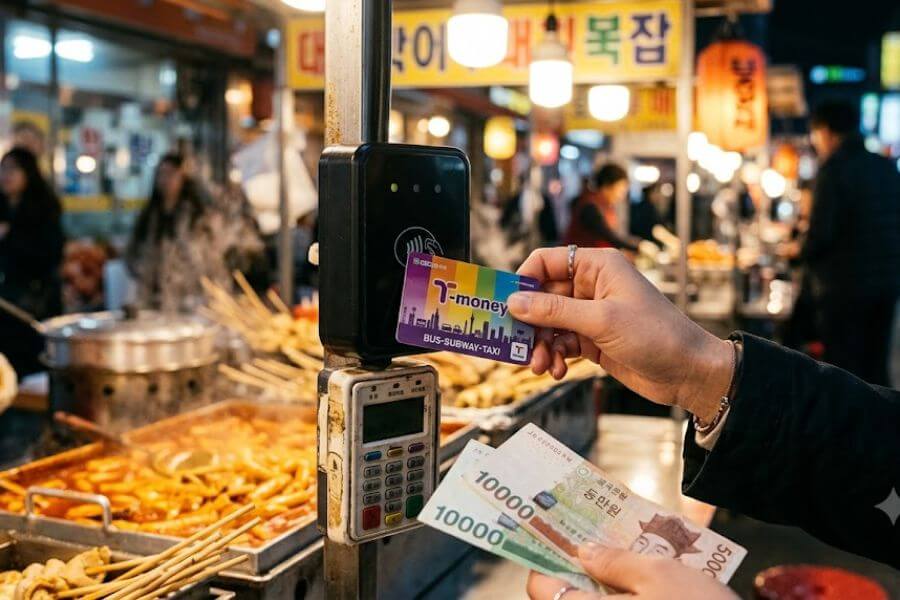
Preparing for a trip to South Korea is incredibly thrilling. You might be dreaming about shopping for the latest skincare trends in Myeongdong, singing your heart out at a karaoke room in Hongdae, or trying delicious sweet pancakes at a busy traditional market. While packing your bags and planning your daily stops are important steps, figuring out how you will actually buy things when you land is just as crucial. South Korea is one of the most technologically advanced places in the world, and the way people handle money there reflects that.
To help you enjoy every single minute of your trip without any awkward moments at the checkout counter, this guide breaks down how to use plastic cards, paper bills, and the famous local transportation passes. You will learn the best ways to swipe, tap, and hand over your funds so you can navigate the entire country like a seasoned local.
The Big Picture of Local Payments
South Korea has shifted heavily toward digital payments over the past several years. Many coffee shops, clothing boutiques, and restaurants in major cities do not even accept paper bills or coins anymore. You will often see small signs at the entrance that read “Card Only” or notice automated touch-screens where you must order and pay by swiping plastic. Because of this, relying entirely on paper currency is not a good strategy.
At the exact same time, you cannot completely abandon physical bills either. If you want to buy a steaming egg-bread from a street vendor, play a game at a classic crane arcade, or reload your public transportation card, you will need physical coins and notes. This creates a dual system where you need a smart mix of payment tools. The perfect travel setup requires balancing plastic cards for major stores and physical notes for small independent businesses. Understanding when to use each method will keep your vacation smooth and stress-free.
plastic Cards and Digital Swiping
Your foreign bank cards will be the absolute backbone of your daily vacation budget. Major brands like Visa and Mastercard are accepted nearly everywhere in the country. You can use them to purchase tickets for high-speed trains, pay for a big dinner of table-side grilled meat, or buy souvenirs at large multi-story department stores.
Knowing the Chip and PIN System
When you use a standard foreign plastic card in South Korea, the clerk will almost always insert the chip into the bottom of the machine rather than sliding the magnetic strip. Contactless tapping with foreign credit cards is becoming more common, but it is still not a universal guarantee at every single tiny store. It is smart to know your four-digit security code before you fly out. Sometimes an automated checkout machine will ask for this number to confirm the purchase, especially if you are buying things from an unmanned kiosk.
Potential Hicrafts with Foreign Accounts
While the acceptance rate for international plastic is high, you might run into sudden roadblocks at smaller independent shops or automated ordering screens. Some local processing systems are set up exclusively for cards issued by domestic Korean banks. When an international piece of plastic is inserted, the machine might display an error message and reject the transaction. To prevent your own bank from locking down your account due to sudden overseas activity, always log into your banking mobile application before your departure date and submit a travel notice.
Dynamic Currency Conversion Warnings
When a clerk hands you the payment machine, the screen might ask you to choose between paying in your own home currency or the local South Korean Won. This choice is called Dynamic Currency Conversion. You should always select the local South Korean Won option. If you choose your home currency, the local processing bank will apply a terrible, inflated exchange rate along with hidden service fees. Selecting the local option allows your personal bank back home to handle the calculation, which almost always results in a much better deal.
The Rise of Mobile Payments
You might be used to tapping your mobile phone for every single transaction back home. In South Korea, local smartphone wallets dominate the scene, while international mobile wallets face a few limitations. Samsung Pay is built into the local infrastructure and works everywhere. Apple Pay has grown significantly across the country and is now supported at major global chains, major convenience stores, and department stores. However, many smaller independent coffee shops and boutiques still lack the specific tap terminals required for international mobile devices. Always carry a physical card in your pocket as a reliable backup plan.
The Power of Specialized Travel Cards
Because international plastic cards can occasionally fail at local automated screens, clever travel companies have created specialized prepaid cards just for international visitors. Two of the most popular options available are the WOWPASS and the NAMANE card. These cards are brilliant because they function exactly like a locally issued South Korean debit card, meaning they are accepted at every single store, restaurant, and automated ordering kiosk across the nation.
How the All-In-One WOWPASS Functions
The WOWPASS is an exceptionally popular tool for international sightseers. You can pick up a blank card at automated orange machines located inside major subway stations, airport terminals, and hotel lobbies. You verify your identity by scanning your physical passport, and then you can feed your home currency bills directly into the machine. The machine instantly converts your money and loads local funds onto the card. The companion mobile application tracks your balances in real time, and you can even freeze the card instantly through your phone if you happen to drop it somewhere.
Custom Designs with NAMANE
The NAMANE card offers a similar prepaid local balance system, but with a highly creative twist. Through their mobile application, you can upload any picture you want, such as a photo of your favorite music group, a pet, or a memorable vacation snapshot. When you locate a NAMANE kiosk in the city, the machine prints your custom image directly onto the front of the plastic. It makes for an incredibly unique souvenir while serving as a fully functional payment tool for meals, clothes, and transport.
The Essentials of Stored-Value Transit Cards
Even if you choose to swipe plastic cards for every single purchase, you absolutely must obtain a specialized local transit card. The most famous and widespread option is the T-Money card. You cannot board local subways or public buses by simply tapping a standard foreign Visa or Mastercard. You must tap a compatible local transit chip against the plastic barrier sensors to pass through.
Where to Acquire Your Transit Card
Finding a basic T-Money card is incredibly simple. They are sold at every single airport convenience store, as well as neighborhood convenience shops throughout the country. A basic piece of plastic usually costs a few thousand Won. The best part is looking through the different designs available at the front counter. You can find cards featuring cute animated characters, local pop stars, or minimalist city patterns.
The Strict Cash-Only Reload Rule
This is the one detail that surprises almost every single first-time traveler: you can generally only load funds onto a standard T-Money transit card using physical paper notes and coins. You cannot use an international plastic card to add funds to a transit card at a subway terminal or a convenience store counter. You must walk up to an automated transit terminal, place your plastic card on the designated reader pad, insert physical paper bills, and wait for the system to update.
Note on Modern Upgrades: If you are using a hybrid travel card like a WOWPASS, the company has added a feature in their mobile application that allows you to shift funds directly from your main prepaid card balance over to your transit balance, removing the need to find an automated terminal. However, for a standard T-Money card, cash is mandatory.
Tapping In and Tapping Out Properly
Using the card on local public transportation requires a specific habit. You must tap your card against the digital sensor plate when you walk through the subway turnstile or step onto a public bus. When you reach your final stop or prepare to exit the bus doors, you must tap the card a second time. Tapping out is vital because the transit system calculates your total fare based on the actual physical distance you traveled. If you forget to tap out when exiting, the system will penalize you by charging the maximum possible distance fee the next time you try to use public transit.
Unlocking the Free Transfer System
The local transit network is highly integrated and offers excellent financial rewards for switching vehicles. If you hop off a subway train and step onto a public bus within a thirty-minute window, the system treats it as a single continuous journey. The transfer is completely free, or it will only cost a tiny distance bonus rather than a whole new fare. This benefit only triggers if you remember to tap out of your first vehicle and tap into the second one correctly.
Buying Extra Items with Transit Funds
A T-Money card is not just for trains and buses. The electronic chip inside is accepted at thousands of retail locations. You can use your transit balance to buy snacks at convenience stores, purchase cold drinks from public vending machines, buy entrance tickets to certain historical palaces, or pay for a ride in a city taxi. It serves as a handy electronic wallet when you do not want to pull out your primary banking cards.
The New Short-Term Unlimited Climate Card
If your travel itinerary keeps you heavily inside the capital city of Seoul, you might want to look into a special alternative called the Climate Card. The local government offers short-term versions of this card tailored specifically for tourists. You can purchase a pass for a set number of consecutive days, such as a one-day, three-day, or five-day option.
After paying a flat fee using physical bills at a station terminal, you get completely unlimited rides on the Seoul subway system and all municipal city buses for the duration of your pass. It can save you a significant amount of money if you plan to hop on and off trains multiple times a day to see different neighborhoods. Just keep in mind that it only operates within the official city borders of Seoul, so it will not cover long-distance trips to other provinces or the entire journey down to specific distant regional airports.
| Transit Option | Best Used For | Funding Method | Key Benefit |
| Standard T-Money | Traveling all over South Korea, including Busan, Jeju, and Seoul | Physical notes and coins at stations or stores | Never expires and works nationwide across various transit types |
| WOWPASS (Prepaid Hybrid) | Travelers who want one single item for shopping and transit | Foreign bills at orange machines or app transfers | Eliminates the need to carry physical currency for train reloads |
| Climate Card (Short-Term) | Intense sightseeing and heavy train hopping inside Seoul city | Physical notes at Seoul subway terminals | Fixed flat price for completely unlimited bus and subway rides |
When Physical Currency is Mandatory
Even though the country runs primarily on digital networks, keeping a small bundle of local physical currency in your bag is absolutely necessary. Physical notes are known as Korean Won. The bills come in denominations of one thousand, five thousand, ten thousand, and fifty thousand Won. Each bill has a distinct color and size, making them easy to identify at a quick glance.
Exploring the World of Street Food
One of the best parts of visiting South Korea is exploring the vibrant night markets and outdoor food rows. When you want to purchase a skewer of spicy grilled chicken, a sweet syrup pancake, or a twist of fried potato from an open-air cart, the independent owners will almost always require physical notes. These tiny mobile carts do not have stable internet connections or digital card terminals. Having small bills like one-thousand and five-thousand Won notes will make these quick transactions fast and polite.
Coin-Operated Entertainment Spots
The youth culture in South Korea loves unique entertainment spaces, and many of these require physical coins. Coin karaoke rooms are small private booths where you insert a couple of silver coins to sing two or three songs. Vintage arcades, photo booths that print custom sticker sheets, and capsule toy machines also rely heavily on physical money. Most of these venues will have a large plastic change machine against the wall that takes a ten-thousand Won bill and breaks it down into shiny five-hundred Won coins.
Navigating Traditional Shopping Markets
If you visit famous older markets like Namdaemun or Gwangjang to look for traditional fabrics, handmade crafts, or regional snacks, physical currency gives you a distinct advantage. While some larger stalls can accept international plastic, the elderly vendors running the smallest stalls prefer physical cash. Sometimes, if you are buying items in bulk, a vendor might even offer you a tiny discount if you pay with physical bills instead of swiping a plastic card.
Smart Strategies for Getting Local Currency
Since you will definitely need some physical notes during your adventure, you need a smart plan to acquire them without paying massive global transaction fees. You have a few distinct paths to choose from, depending on whether you prefer to plan ahead or handle everything after you land.
Avoiding Airport Foreign Exchange Booths
The physical exchange counters located inside international arrival halls are incredibly convenient, but that convenience comes with a heavy price. These desks know that tired travelers are anxious to get local money immediately, so they offer some of the worst exchange rates you will find anywhere. They also tack on high service fees. It is much smarter to exchange only a tiny amount of money at the airport to cover your initial train ticket into the city center, and then look for better options once you arrive at your hotel.
Utilizing International ATMs Safely
The most efficient way to get physical notes is to withdraw them directly from a local bank teller machine using your home debit card. Look for machines that have a bright sign reading “Global ATM” or display a button for international cards on the introductory touch-screen. Regular local bank machines that lack this global software will simply reject your foreign card right away.
When you make a withdrawal, try to pull out a substantial amount all at once rather than making five or six tiny trips. Your home bank will likely charge a flat overseas terminal fee for every single transaction, so fewer visits will save you money over time. Stick to automated machines located inside major, well-lit bank branches during official daylight business hours. If the machine happens to retain your plastic card due to a technical error, you can simply walk up to the security counter and ask the staff for immediate help.
Neighborhood Currency Exchange Booths
If you prefer to carry physical bills from your home country, you can swap them for local notes at independent exchange shops in popular tourist districts like Myeongdong or Dongdaemun. These small shops consistently offer excellent, highly competitive rates that beat the banks. You will see digital screens displaying the current global values outside their windows. Always bring your physical passport with you, as local laws require these businesses to log your identity before handing over physical local currency.
Tipping Customs and Etiquette
When it comes to paying your bill at the end of a wonderful meal, understanding local social rules is just as important as knowing which card to swipe. South Korea has a wonderful culture around service, but it operates differently than what you might be used to back home.
The No-Tipping Rule
There is absolutely no tradition of tipping in South Korea. Whether you are riding in a city taxi, eating a gourmet meal, getting a fashionable haircut, or staying at a boutique hotel, you should never leave extra cash on the table. If you leave extra coins behind on a restaurant table, the waiter will likely sprint down the sidewalk after you to return the money you forgot. The total price displayed on the menu or the digital screen is the exact amount you are expected to pay. Excellent service is considered a standard duty, and workers are paid regular wages by their employers.
Handling the Bill at Restaurants
In many Western countries, the waiter brings a small black folder to your table at the end of the meal and processes your card right beside your chair. In South Korea, the process is centralized. When your food is served, the waiter will usually slide a physical clipboard or a small printed paper slip to the edge of your table.
When you are finished eating, you take that paper slip yourself and walk up to the front payment counter near the exit doors. The cashier will scan the paper and process your card or cash there. If you are dining with a large group of friends, it is best for one person to pay the entire bill at the counter and have everyone else send them money later. Trying to split a single dinner bill across five different international credit cards can cause a major delay at a busy checkout register.
Frequently Asked Questions
Can I travel around South Korea using only international credit cards?
You cannot rely completely on international credit cards for your entire journey. While major stores and restaurants accept foreign cards, you will need physical notes to reload your public transportation passes, purchase street food, and play games at local entertainment arcades. Some automated ordering terminals might also reject cards that were not issued by a domestic Korean bank.
What should I do if a local automated ordering machine rejects my foreign bank card?
If an automated machine refuses your international card, you can try to insert a different card from a separate banking network. If that fails, look for a staff member and ask if you can pay with physical currency instead. A fantastic way to prevent this issue entirely is to get a specialized local travel card like a WOWPASS, which uses domestic networks and is accepted at all automated local terminals.
Is it possible to use a T-Money transit card in cities outside of Seoul?
The T-Money card is incredibly versatile and operates perfectly across almost all major regions in South Korea. You can use it seamlessly on the subway systems and public buses in cities like Busan, Daegu, and Daejeon, as well as in smaller regional towns. It is a true nationwide transit tool.
Can I reload my T-Money card using an application on my phone?
If you are using a standard plastic T-Money card bought at a convenience store, you generally cannot reload it through a mobile application using an international credit card. You must use physical paper bills at a subway terminal or a convenience store counter. However, if you use a hybrid travel card like a WOWPASS, you can manage and transfer your transit balances using their official application.
What happens to the leftover money on my transit card when my vacation ends?
If you have leftover funds on your transit card at the end of your trip, you can take the card to a customer service desk inside a subway station or to a local convenience store clerk. You can request a cash refund for the remaining balance. They will hand you the remaining money in physical notes, minus a small processing fee of a few hundred Won. If you prefer, you can also keep the card as a souvenir, since the balance remains valid for five years and the card itself never expires.
Do taxis in South Korea accept credit cards and transit cards?
Virtually every single taxi operating in South Korea is equipped with a digital payment terminal mounted next to the dashboard. You can easily pay for your ride using a standard international credit card, a specialized local travel card, or your T-Money transit card. You only need physical notes for a taxi ride if the digital terminal happens to suffer a sudden network failure.
Are there any specific places where physical paper notes are still preferred over digital cards?
Physical paper currency is highly preferred or mandatory at open-air street food stalls, traditional neighborhood craft markets, vintage coin arcades, public vending machines, and self-service photo booths. Keeping around thirty thousand to fifty thousand Won in physical notes in your wallet at all times will prepare you for these fun local spots.