If you are stepping off the plane as a US expat launching a new career or an international student arriving for a semester in Seoul, your very first mission is to get your finances sorted out. You might think you can get by with your home country credit cards or by carrying pockets full of paper money, but you will quickly find out that local life revolves around having a domestic bank account. From paying your monthly rent to ordering late-night fried chicken on a food delivery app, a local card is your ultimate golden ticket to navigating this beautiful country.
Navigating the financial system in a brand new country can feel intimidating when you do not speak the local language fluently, but this detailed guide will take you through every single step of the process. You will learn about the exact paperwork you need to gather, which specific branches cater best to foreigners, and what to expect when you finally sit down across from a bank teller. Grab your notebook and let us dive straight into setting up your new financial life in South Korea.
Why You Need a Local Account Immediately
South Korea operates on a highly advanced, deeply integrated digital financial system that requires real-name verification for almost everything. Your foreign credit card might work at major department stores or international hotel chains, but it will fail you in everyday local scenarios. If you want to experience the true convenience of living in this country, a local bank account is non-negotiable.
The Real Name Verification Dilemma
In South Korea, your identity is digitally tied to your phone number and your bank account. When you try to sign up for local apps, online shopping portals, or even high-speed internet for your apartment, the system will ask you to verify your identity through your phone. You cannot get a permanent, postpaid mobile phone plan without a local bank account to handle the automatic monthly bill payments. This creates a chain reaction where you need the bank account to get the phone number, and you need the phone number to use the apps. Setting up your account breaks this cycle and unlocks the digital world around you.
Conquering the Public Transportation System
While you can buy standard plastic transit cards at convenience stores and top them up with physical cash every few days, it becomes a tedious chore very quickly. When you get a Korean debit card, it usually comes with a built-in feature called Hoo-bultong-sin, which means post-paid transit. You can tap your bank card on buses and subways across the entire country, and the total fare is automatically calculated and deducted from your account once a month. This saves you from standing in long lines at subway stations just to add money to a temporary card.
Seamless Online Shopping and Food Deliveries
South Korea is famous for its hyper-efficient delivery services where you can order groceries at midnight and find them on your doorstep by dawn. However, these local applications almost never accept foreign credit cards. To tap into the world of instant online shopping, you need a local card or the ability to make a quick bank-to-bank transfer, which is the preferred method of payment for most independent sellers and small businesses.
Choosing the Best Bank for Your Needs
South Korea has several massive commercial banking institutions, and while they all offer secure services, some are far friendlier to expats and students than others. Choosing the right institution depends on where you live, your language comfort level, and the specific perks you want to access.
KEB Hana Bank
This institution is widely considered the top choice for foreigners, expats, and international students. They have spent years building a reputation as the most globally minded bank in the country. Many of their branches feature dedicated international centers with staff members who speak excellent English. Their mobile banking application is highly optimized for foreign users, offering full English support and a relatively simple interface that does not require you to jump through hoops.
Woori Bank
If you are entering South Korea on a student visa, there is a very high probability that Woori Bank will become your financial home. This bank forms strong partnerships with major universities all over the country. They often set up temporary pop-up booths right inside university campuses during orientation week to help thousands of international students open accounts simultaneously. Their mobile application is reliable, and they have an enormous network of automated teller machines scattered across every major city.
KB Kookmin Bank
As one of the absolute largest financial institutions in South Korea, KB Kookmin has a branch on almost every major street corner. If you are living outside the main metropolitan hub of Seoul, this wide network is incredibly valuable. While their English support can vary depending on the specific branch you visit, their stability and sheer volume of locations make them an excellent choice for expats who plan to travel extensively around the rural areas of the country.
Shinhan Bank
Shinhan Bank is another financial giant that offers specialized services for foreign residents. They provide a dedicated smartphone application tailored specifically for international users, which simplifies the process of sending money back to the United States or other home countries. Their customer service hotlines feature robust foreign language support, making it easier to solve problems over the phone without having to visit a branch in person.
Essential Documents for US Expats
If you are moving to South Korea as an English teacher, a corporate executive, or a digital nomad on a long-term visa, your document checklist is strict. The financial authorities regulate account creation heavily to prevent international fraud, so you must bring the exact paperwork required.
The Residence Card
Formerly known as the Alien Registration Card, your Residence Card is your primary legal identification document while living in the country. It is a plastic card that displays your legal name, visa status, and unique registration number. Most banks will refuse to open a fully functional, unrestricted bank account unless you present this card. Because it can take several weeks after your arrival for the immigration office to print and deliver this card, you must plan your bank visit accordingly.
Your Valid US Passport
Even though you have a local Residence Card, you must always bring your original physical passport to the bank. The clerk will scan the photo page to verify your citizenship and double-check that the spelling of your name matches your local identity card down to the very last letter.
Proof of Active Local Employment
Due to strict anti-money laundering laws, banks are required to verify the exact purpose of your account. If you are an expat working a local job, you must request a Certificate of Employment from your school or company. This document must be fresh, officially stamped, and written in either Korean or English. If you have already started working, bringing a copy of your recent employment contract or a formal pay stub will strengthen your application.
Tax Reporting Paperwork for US Citizens
Because you are a US citizen, you fall under a special federal law known as the Foreign Account Tax Compliance Act. This law requires foreign financial institutions to report the account balances of US citizens back to the Internal Revenue Service. When you sit down at a Korean bank, the clerk will hand you a specific tax form to fill out where you must provide your US Social Security Number. Do not forget to have this number memorized or written down securely before you walk into the building.
Essential Documents for International Students
International students face a slightly different set of rules. Because you are generally not earning a full-time salary, the bank needs to confirm your academic status and ensure you have a legitimate reason for handling local currency.
Student Visa and Passport
You must present your physical passport containing your valid student visa stamp or your digital visa confirmation printout. Just like expats, you will also need your local Residence Card if it has already been issued to you by the immigration authorities.
Official Certificate of Enrollment
You cannot simply tell the bank that you are a student; you must prove it with official documentation from your university registry. You will need a Certificate of Enrollment or an official Letter of Admission. These documents must show that you are currently registered for classes in the current semester.
Proof of Local Korean Address
The bank needs to know exactly where you are sleeping at night to send you official statements and verify your residency. If you are living in a university dormitory, you can request a Certificate of Dormitory Residency from the housing office. If you are renting a small private apartment near campus, you must bring your original physical lease agreement showing your name and the complete address written in Korean.
Understanding the Two-Stage Account Opening Process
One of the biggest surprises for new arrivals is that you might not get a fully operational bank account on day one. Because it takes time to get your permanent identity cards, many foreigners utilize a two-stage approach to manage their money safely.
Stage One: The Temporary Passport Account
If you land in South Korea and need a place to store your travel cash immediately before your Residence Card arrives, you can visit a bank with just your passport and a local address. The teller can open a highly restricted account for you. This account is excellent for keeping your funds safe, but it comes with massive limitations. You generally will not receive a standard debit card, you cannot use automated teller machines for withdrawals without walking up to a counter, and you will be completely blocked from using online smartphone banking.
Stage Two: Upgrading to a Full Account
Once your official plastic Residence Card arrives in your mailbox, you must return to the exact same bank branch to upgrade your status. The clerk will scan your new card, update your profile in their computer system, link your real-name mobile phone number, and unlock the full potential of your account. At this point, they will issue you a fully functional debit card and help you set up your mobile banking application.
Step-by-Step Guide to Your Bank Visit
Walking into a bustling financial institution in a foreign country can cause your heart to race. Knowing exactly what happens from the moment you step through the glass doors will help you stay calm and collected.
Timing Your Arrival Perfectly
Korean bank branches have specific operational hours, typically opening at nine in the morning and closing their doors at four in the afternoon. They do not operate on weekends. The absolute best time to visit is mid-morning on a Tuesday or Wednesday. Avoid the lunch hour between noon and two in the afternoon at all costs, as local workers flood the branches during their breaks, causing wait times to stretch for over an hour.
Taking a Queue Ticket
When you walk through the front doors, you will see a small electronic kiosk that dispenses paper queue tickets. The buttons on the machine are usually labeled in both Korean and English. For opening a brand new account, you want to press the button that says General Banking or Deposit/Withdrawal. Take the small paper slip and look at the glowing digital screens above the teller counters to see how many people are ahead of you.
Sitting Down with the Teller
When your ticket number flashes on the screen with a chime, walk over to the corresponding desk. Start the conversation with a friendly smile and a polite greeting. If you do not speak Korean, you can simply say, “Hello, I would like to open a bank account in English, please.” If the teller is not comfortable speaking English, they will often call over a colleague or guide you to a specialized international desk.
Navigating the Mountain of Signatures
The teller will take your stack of documents and begin typing your information into their computer terminal. They will hand you a series of electronic tablets or paper forms with highlighted boxes. You will need to sign your legal name dozens of times. Make absolutely sure that the signature you use matches the signature on the back of your US passport exactly. You will also be asked to type a four-digit personal identification number into a small secure keypad on the desk. This will be the permanent password for your debit card and account access.
The Mystery of the Korean Passbook
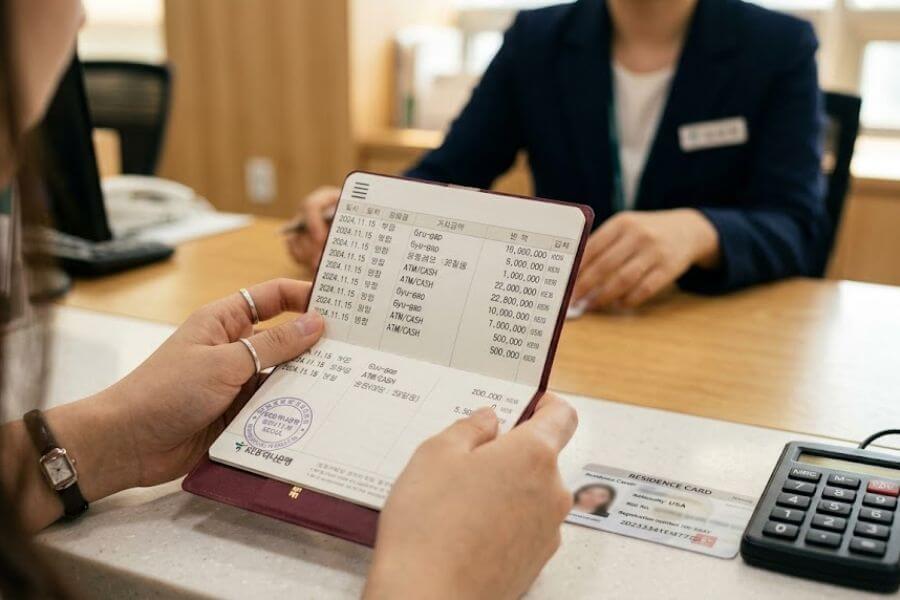
When your account setup is complete, the teller will not just hand you a plastic card; they will present you with a small, physical paper booklet called a Tong-jang. For many Westerners, this feels like a trip backward in time, but in South Korea, the passbook is a deeply respected cultural and financial staple.
What is a Bank Passbook?
The passbook is a physical diary of your financial history. It contains your exact account number, your legal name, the branch code, and rows of empty pages. When you insert this booklet into any automated teller machine across the country, the machine will mechanically flip to the correct page and print your recent transactions using ink.
How to Protect Your Passbook
While mobile apps have reduced the daily need to carry your passbook around, it remains a powerful legal document. Many older landlords will ask to see a physical printout of your passbook pages to confirm your identity before signing a housing contract. Keep this booklet in a safe, dry place at home alongside your passport. If you ever lose it, you will have to pay a small fee at the bank branch to have a new one printed.
Decoding the Korean Debit Card
Your plastic debit card is called a Check Card in South Korea. It works instantly by pulling funds directly from your checking account balance whenever you tap it at a store or restaurant counter.
The Power of the IC Chip
Korean payment terminals rely almost exclusively on reading the metallic integrated circuit chip on your card rather than the magnetic swipe strip. When you buy something at a convenience store, you will hand your card to the cashier, who will insert it vertically into the bottom of their point-of-sale terminal. Leave the card there until the machine chirps and prints your paper receipt.
Choosing Your Card Features
When the teller prepares your Check Card, they will ask you if you want to add specific add-on features. You should always say yes to the post-paid transit option so you can use the card on subways. They might also ask if you want your card to have cash-card capabilities, which allows you to use the physical card to withdraw paper bills from automated teller machines.
Aesthetic Options and Characters
Korean culture loves cute designs, and banks are no exception. Many institutions partner with famous media companies to feature adorable cartoon characters on the front of their debit cards. Do not be surprised if the teller asks you to choose between a standard corporate blue design or a card featuring a giant, smiling animated bear. Feel free to pick the one that makes you smile.
Setting Up Mobile and Online Banking
You cannot truly survive in South Korea without access to smartphone banking. However, the security protocols surrounding digital finance are incredibly strict and require a few extra steps to configure correctly.
The Security Card Barrier
When you set up online banking at the counter, the teller will hand you a small plastic card that looks like a credit card covered in rows of numbers. This is called a Security Card or Bo-an Card. Whenever you try to transfer money to a friend or pay a bill using your phone, the app will ask you to type in specific digits from this card to verify the transaction. Do not throw this card away, and never post a picture of it online. Newer systems sometimes use digital OTP tokens, which generate a rotating sequence of numbers on a separate key fob device.
Navigating the App Store Maze
To use your account on your phone, you will need to download the official banking application from the Apple App Store or Google Play Store. Be prepared for the fact that Korean digital security often requires you to install a couple of secondary applications alongside the main bank app. These secondary programs act as digital anti-malware shields and secure keyboards to keep your financial data safe from hackers.
Managing Digital Certificates
To finalize large financial transactions on your phone, you will need to generate a digital identity certificate through the app. This acts as your official electronic signature. The banking staff are highly trained to help foreigners navigate this setup process. Before you leave your teller counter, make sure you open the app on your phone and verify that you can see your balance in English.
Navigating Account Limitations for Foreigners
To combat financial crimes and telephone phishing scams, the South Korean government places strict default limits on all newly opened accounts, especially those belonging to foreign nationals.
The Standard Daily Limits
When you first walk out of the bank, your account will likely be classified as a restricted account. This means you will face a daily withdrawal limit at automated teller machines of around three hundred thousand Korean won, which is roughly equivalent to two hundred and thirty US dollars. Your daily online transfer limit will likely be capped at the same amount.
How to Lift the Restrictions
These low limits can become a massive headache when it comes time to pay your monthly rent or buy an expensive appliance. To lift these financial handcuffs, you must prove a pattern of legitimate account usage over time. If you are an expat, bringing in an official document that proves you have paid your local utility bills or showing a consistent direct deposit from your employer for three consecutive months will allow the bank to lift your limits. Students can sometimes get their limits raised by showing a formal tuition bill that needs to be paid directly to their university.
Sending Money Back Home to the United States
As a US expat earning a salary in Korean won, or a student who accidentally overfunded their local account, you will eventually need to send money across the ocean back to your US bank.
The Traditional Wire Transfer
You can perform a standard international wire transfer by walking into your local branch or using the smartphone app. You will need to provide your US bank name, their specific routing number, your personal account number, and a unique international code known as a SWIFT code. While this method is highly secure and handles massive amounts of money well, the traditional banking network often charges high flat fees on both the sending and receiving ends.
Specialized Foreign Remittance Accounts
To make things easier for expats, many Korean institutions offer a special type of account called an overseas remittance account. When you set this up, the bank links a special virtual account number to your primary checking account. Whenever you deposit local Korean won into that specific virtual account, the bank automatically converts the funds into US dollars and wires them directly to your pre-registered US bank account without you having to fill out paperwork every single time.
Understanding Bank Fees and Interest Rates
While keeping your money in a bank is incredibly safe, you must keep an eye on the minor operational fees that can quietly nibble away at your balance if you are not careful.
Automated Teller Machine Charges
Using an automated teller machine that belongs to your specific bank during standard business hours is almost always completely free. However, if you need to withdraw physical cash late at night on a weekend, or if you use a machine belonging to a competitor bank, you will be charged a small convenience fee ranging from five hundred to one thousand Korean won per transaction.
Account Maintenance Fees
Unlike many major retail banks in the United States that charge heavy monthly service fees unless you maintain a massive minimum balance, South Korean checking accounts are generally free to maintain. You do not have to worry about your balance dropping down to zero during a lean student semester; the bank will not penalize you with surprise maintenance charges.
Navigating Local Interest Rates
Standard checking accounts in South Korea offer virtually zero interest. If you are an expat looking to grow your savings while living abroad, you should ask a teller about setting up a specialized savings account called a Jeok-geum. These accounts require you to deposit a fixed amount of money every month for a set period, such as one year, in exchange for a much higher, guaranteed interest rate.
Cultural Tips for a Smooth Financial Life
Banking in South Korea is not just about numbers and paperwork; it is also about cultural respect and understanding local etiquette. Following a few simple unwritten rules will make your financial life incredibly smooth.
The Two Handed Rule
Whenever you hand your passport, your Residence Card, or your pen back to the bank teller, you should always hold the object with both of your hands while giving a slight, polite nod of your head. This simple gesture demonstrates deep respect in Korean culture and will instantly put the staff in a wonderful mood to help you solve any complex issues.
Keeping Your Name Consistent
When you fill out any official document in South Korea, from your housing lease to your mobile phone contract, make sure your name is written exactly as it appears on your passport and Residence Card. If your middle name is included on your passport, it must be included on your bank account. If a single letter is out of place or if your names are flipped in the wrong order, the automated digital tracking systems will fail to verify your identity, and your cards will be blocked.
Summary Comparison of Top Korean Banks
To help you visualize your options at a single glance, this table outlines the distinct advantages and focuses of the four primary commercial banking options available to you.
| Bank Name | Primary Focus | Language Support | Best Fit For |
| KEB Hana Bank | Global Expats | Excellent English App and Staff | Corporate Workers and Travelers |
| Woori Bank | University Students | Good Campus Support | International Exchange Students |
| KB Kookmin Bank | Nationwide Coverage | Moderate Branch Support | Expats Living Outside Major Cities |
| Shinhan Bank | Digital Innovation | Dedicated Foreigner App | Tech Savvy Digital Nomads |
Frequently Asked Questions
Can I open a Korean bank account before I arrive in South Korea?
No, you cannot open a standard, functioning domestic bank account while you are still physically sitting in the United States. South Korean financial regulations require a face-to-face identity verification process at a physical branch counter inside the country. You must wait until you touch down on Korean soil to begin the formal application process.
What should I do if I lose my Korean debit card?
If your card vanishes, you must act quickly to secure your funds. Open your bank smartphone application immediately to look for a button that allows you to temporarily freeze or report your card as lost. Alternatively, you can call the bank customer service hotline, which features an English language menu option. To get a replacement card, walk into any branch of your bank with your passport and Residence Card, and a teller will print a brand new plastic card for you in less than ten minutes.
Can I use my Korean debit card to make purchases on websites outside of Korea?
By default, most standard domestic Check Cards are locked for international use to protect your account from overseas fraud. If you plan to use your local card to buy flights on American websites or order items from international online stores, you must specifically ask the bank teller to enable global functions on your card during your branch visit. Look for a small Visa or Mastercard logo printed on the front of your card to ensure it can handle global networks.
Do I need to close my account when I leave South Korea permanently?
Yes, it is highly recommended that you formally close your account before you pack your bags and board your flight back home. If you leave your account open with money inside, it can become dormant over time, making it incredibly difficult to retrieve your funds from overseas. Walk into a branch during your final week in the country, settle any outstanding balances, transfer your remaining funds to your US account, and ask the teller to officially close your profile.