Packing your bags for South Korea is an exciting feeling. You might be dreaming about the glowing streets of Seoul, the beautiful beaches of Busan, or the delicious smell of sizzling Korean barbecue. The food, the music, the fashion, and the history draw millions of travelers every year. But before you step off the plane, there is something just as important as your passport: understanding how to behave.
Korean culture is beautiful, deep, and built on mutual respect. It is a society where people closely look out for one another. Because of this, certain behaviors that seem completely normal back home might surprise or even upset the locals you meet. You do not need to feel stressed, though. Koreans are incredibly kind and forgiving toward foreign travelers. Still, making an effort to follow their customs shows that you value their way of life. This guide will walk you through the essential cultural habits so you can blend in perfectly and build wonderful memories.
Key Takeaways for a Smooth Journey
If you only remember a few concepts from this guide during your trip, focus on these three core ideas. They form the foundation of almost every social rule in the country.
- Respect the Elders: Age carries massive weight in South Korea. Always give up your seat, bow lower, and use two hands when interacting with anyone older than you.
- Keep the Peace in Public: Public spaces are shared zones of quiet comfort. Avoid loud talking, intense emotional displays, and messy habits on subways, buses, or street corners.
- The Power of Two Hands: Whether you are paying for a cheap snack, passing a business card, or pouring a drink, using both hands shows that the other person has your full attention.
1. The Art of Bowing and Greeting
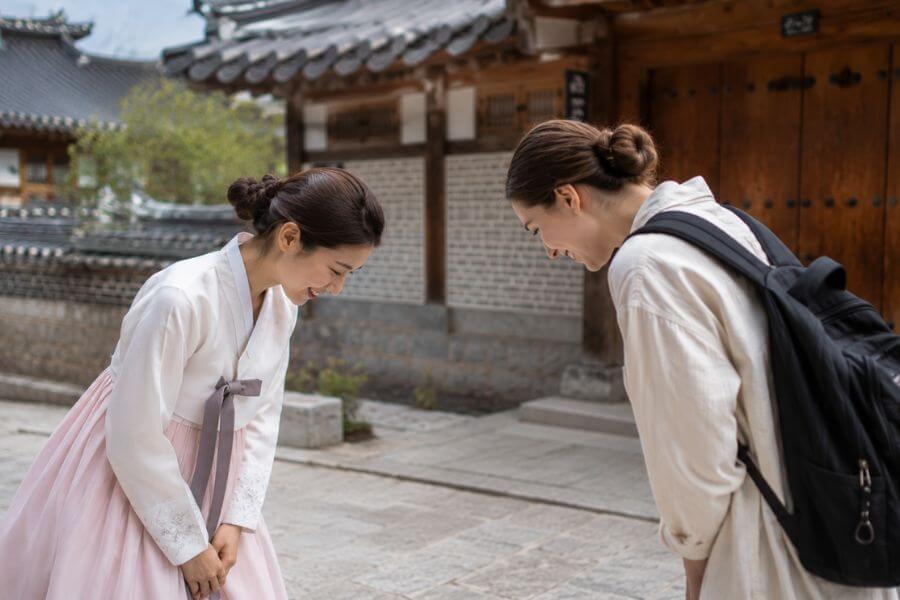
When you meet someone in South Korea, do not reach out for a firm, western-style handshake right away. The traditional greeting is a bow. Bowing is not just a physical movement. It is a visual representation of your humility and respect for the other person.
How to Bow Correctly
You do not need to bend completely in half. For everyday interactions, like walking into a convenience store or greeting a hotel clerk, a slight bend from the waist at about fifteen to thirty degrees is perfect. Keep your eyes lowered rather than staring directly at the person as you bow. Keep your hands neatly at your sides or folded politely in front of your stomach.
Handshakes with a Twist
Handshakes do happen, especially in business settings or when locals want to make foreign visitors feel comfortable. However, a Korean handshake is different. Never grab a hand with one hand while keeping your left hand in your pocket. That looks incredibly dismissive. Instead, extend your right hand to shake, and place your left hand gently under your right forearm or wrist for support. Alternatively, you can place your left hand over your heart. This extra touch of support shows that you are putting your whole heart into the greeting.
Helpful Greeting Guide
| Situation | Who You Meet | Proper Action |
| Casual Shopping | Store clerks, waiters, taxi drivers | A quick fifteen-degree bow with a smile |
| Meeting a Friend’s Parent | Elders, teachers, older individuals | A deeper thirty-degree bow, using polite words |
| Business or Formal | Partners, guides, hotel managers | A polite bow followed by a two-handed handshake |
2. Master the Two-Hand Rule
Imagine you are buying a beautiful souvenir at a market in Insadong. You hand your credit card to the shop owner with one hand, tossing it onto the counter. To you, it is a fast transaction. To the shop owner, it can feel like you are throwing the object at them.
Passing and Receiving Items
Whenever you give or take something in South Korea, you must use both hands. This applies to money, credit cards, gifts, documents, and even a bottle of water. Using both hands means you are fully present in the moment and that you respect the exchange.
The Support Method
If an object is too small to hold with two hands, use your right hand to give or take the item. At the same time, place your left hand under your right wrist or forearm. This looks like you are supporting your own arm because the gift or card is precious. It takes a little practice, but once you start doing it, it becomes an automatic sign of politeness that locals notice immediately.
3. Dining Table Etiquette and the Elders
Korean food culture is legendary, but sharing a meal is about more than just stuffing your face with kimchi and fried chicken. The dining table is a place where social hierarchies are strictly observed.
Wait for the Signal
When you sit down for a meal with Korean acquaintances or a local host, do not grab your chopsticks the moment the food arrives. Look around the table first. The oldest person or the highest-ranking person must pick up their utensils and take the very first bite. Once they begin eating, it acts as a green light for everyone else to start enjoying the feast.
Pacing Yourself
As you eat, keep an eye on the elders at the table. Try to match their eating speed. Finishing your food way before them can make it look like you are rushing them. On the flip side, eating too slowly might make them feel like they have to wait around for you. When the meal concludes, place your utensils back on the table or the provided rest only after the oldest person has put theirs down.
4. Handle Your Chopsticks with Extreme Care
Chopsticks and spoons are the tools of every Korean meal. Unlike some other Asian cultures where you might hold your rice bowl up to your mouth, in South Korea, your bowl stays firmly on the table. You bring the food up to your mouth using your utensils.
The Ultimate Dining Taboo
There is one massive mistake you must avoid at all costs: never stick your chopsticks vertically down into a bowl of white rice. When you do this, it looks exactly like the incense sticks burned at traditional Korean funerals to honor the spirits of the dead. Doing this at a happy dinner table brings bad luck and can deeply upset the people eating with you.
Where to Put Your Utensils
When you need to take a break to drink water or chat, simply rest your chopsticks and spoon on the small ceramic holder next to your plate. If there is no holder, you can rest the clean tips on the edge of a side dish plate or flat on the clean table mat. Also, avoid pointing at people with your chopsticks while talking. It is just as rude as pointing with your finger.
5. Navigating the Rules of Drinking Culture
Alcohol plays a massive role in building friendships and sealing business deals in South Korea. If you choose to drink, you will quickly see that pouring alcohol is an intricate dance of respect.
Never Pour Your Own Drink
The golden rule of Korean drinking is that you never fill your own cup. It is a communal activity. You watch out for others, and they watch out for you. Keep an eye on the glasses around you. If you notice a friend’s glass is empty, offer to refill it for them. Remember to use both hands to hold the bottle—right hand around the glass or bottle, left hand supporting your forearm.
Receiving and Drinking
When someone offers to pour a drink for you, pick up your glass with both hands and hold it out toward them. As they pour, bow your head slightly as a thank you. When it is time to take a sip, do not drink directly in front of an older person. It is polite to turn your head and torso slightly away from the elders, covering your mouth and glass with your hand as you swallow. This shows that you are hiding the act of drinking out of respect for their superior social status.
6. Take Your Shoes Off at the Door
The floors of Korean homes are traditionally clean, warm, and used for multiple purposes. Families sit on the floor, eat on the floor, and sometimes sleep on the floor on comfortable mats. Because of this, bringing the dirt, mud, and dust of the outside world into a home is a major health and cultural offense.
Look for the Raised Floor
When you enter a Korean home, a traditional guesthouse, or even certain traditional restaurants, you will see a small entryway called a hyeonwan. This area sits slightly lower than the rest of the house. Step into this space, unlace your shoes, and step up onto the main floor without letting your bare feet touch the lower entryway ground where the dirty shoes sit.
Indoor Slippers vs. Bathroom Slippers
Often, your host will provide a pair of indoor slippers for you to wear. Slip these on immediately. However, pay attention when you go to the restroom. There will be a specific pair of plastic, waterproof slippers sitting just inside the bathroom door. You must take off your indoor slippers, leave them outside the bathroom, and slide into the bathroom slippers. When you exit, switch them back. Forgetting to do this and walking back into the living room with wet bathroom slippers is a classic tourist mistake that makes hosts cringe.
7. Subway and Public Transit Manners
South Korea has one of the cleanest, fastest, and most efficient public transportation systems on Earth. Trains and buses run exactly on time, and they remain incredibly clean because riders follow a strict unwritten code of behavior.
The Quiet Zone
When you board a subway car in Seoul, you will instantly notice something shocking: it is often completely quiet, even when packed with hundreds of people. Locals do look at their phones, but they wear headphones. If you are traveling with friends, keep your conversation to a whisper. Avoid laughing loudly or making animated hand gestures. If your phone rings, switch it to silent mode immediately. If you must answer an urgent call, keep your voice extremely low and wrap up the conversation in a few seconds.
The Sacred Seats
At the ends of every subway car, you will see designated rows of seats, usually marked with different colors or signs showing elderly people, pregnant women, and individuals with disabilities. Even if the train is completely full and those seats are totally empty, do not sit in them. Those seats are reserved exclusively for the people who need them. Locals would rather stand for an hour with sore feet than take a reserved seat. Sitting there as a young, healthy traveler will earn you some intense, angry stares from everyone in the car.
8. Dress Appreciately and Modestly
South Korea is a major global fashion hub. People love to look stylish, neat, and well-dressed whenever they leave the house. However, their ideas about modesty might be a bit different from what you are used to back home.
Tops vs. Bottoms
In Korean fashion, there is an interesting balance. It is incredibly common and socially acceptable for women to wear very short skirts, shorts, or dresses. You will see this everywhere in youth districts like Hongdae. However, showing off the upper body is viewed very differently. Low-cut tops that show cleavage, shirts that expose the shoulders, or thin-strap tank tops are generally seen as overly revealing or inappropriate for public wear.
Dressing for Special Sites
If you plan to visit temples, historical palaces, or traditional villages, dress conservatively. Opt for t-shirts that cover your shoulders and chest, and pair them with pants or longer skirts. When visiting religious sites, looking neat and covered shows reverence for the spiritual history of the space.
Quick Clothing Checklist
- Acceptable: Short skirts, high-waisted shorts, oversized shirts, trendy sneakers.
- Avoid in Public: Deep v-neck shirts, backless tops, showing bare shoulders at temples, visible underwear straps.
- Tip: Always wear clean, hole-free socks, since you will be taking your shoes off frequently.
9. Tipping is Not Allowed
For travelers coming from countries with heavy tipping cultures, going out to eat can feel confusing at first. In South Korea, the price you see on the menu is exactly the price you pay. Tax is already included, and tipping is simply not a part of the culture.
Why Tipping Can Offend
If you leave extra cash on a restaurant table or try to hand a few bills to a taxi driver, they will not see it as a generous gift. Instead, they will assume you forgot your change. They might chase you down the street to hand the money back to you. In some cases, forcing a tip on someone can feel insulting, as if you think they do not make a good living or that you are trying to show off your wealth.
How to Show Appreciation
If you receive incredible service from a tour guide, a helpful waiter, or a friendly hotel worker, the best way to say thank you is with your words and your actions. Give them a polite, deep bow, look them in the eyes, and say “Kamsahamnida” (Thank you). Writing a glowing online review mentioning their name is another fantastic way to reward great service without causing cultural confusion.
10. The Intricacies of Trash Disposal
When you walk around major cities like Seoul, you might notice something strange: there are almost no public trash cans on the sidewalks. Yet, the streets are remarkably clean. South Korea takes waste management and recycling incredibly seriously.
The System of Sorting
The country uses a strict system called jongnyangje. Trash must be carefully separated into specific categories: general waste, recyclable plastics, glass, paper, cans, and food waste. Residential areas and hotels have designated stations with color-coded bins for each type of waste. Trash bags are even color-coded by neighborhood, and residents buy them at local convenience stores.
What to Do with Your Trash
As a traveler, do not just toss your plastic coffee cup into a random bin or leave it on a street bench. Carry your trash with you until you find a designated disposal area. You can find recycling bins inside subway stations, next to public restrooms, or inside convenience stores where you bought the items. Sorting your trash correctly helps protect the environment and keeps local neighborhoods looking beautiful.
11. Beware of the Red Ink Superstition
This rule sounds like a scene from a movie, but it is a deeply rooted cultural belief that you should respect while traveling or writing postcards.
The Link to the Past
In ancient times, the names of deceased people were written in red ink on official family registers and funeral documents to signify that they had left the world of the living. Because of this historical connection, writing a living person’s name in red ink is considered a massive taboo.
The Meaning Today
If you write someone’s name in red ink today, it carries a dark meaning. It can imply that you want that person to pass away, or that you see them as an enemy. If you are signing a document, filling out a form at a hotel, or writing a sweet note to a local friend, always use black or blue ink. Keep the red pens tucked away for editing text or grading papers only.
12. Be Careful with Public Displays of Affection
South Korea is a romantic country, famous for its romantic dramas, couple outfits, and sweet holidays. You will see couples holding hands, wearing matching shirts, and walking closely together through parks. However, there is a clear boundary when it comes to physical intimacy in public.
Where to Draw the Line
While holding hands or a quick hug is totally fine, heavy kissing, intense touching, or lounging all over each other on public benches or subway cars is frowned upon. Older generations view these displays as deeply uncomfortable and inappropriate for shared spaces.
Respecting the Environment
To avoid making the people around you feel awkward, save the intense romance for private spaces, your hotel room, or quiet evening walks in less crowded areas. Keeping your public affection simple and sweet ensures that everyone around you feels comfortable.
13. Temple Etiquette and Sacred Spaces
Buddhist temples are scattered all over South Korea, nestled in misty mountains and hidden inside bustling cities. Visiting them offers a peaceful look into the spiritual history of the country. To maintain that peace, you must follow specific behaviors.
Entering the Building
When you walk into a main temple hall, look at the doorways. Never walk directly through the central door. That entrance is reserved for the monks and spiritual leaders. Instead, use the side doors on the left or right. As you cross the threshold, be careful not to step directly onto the wooden raised door frame. Step completely over it. Stepping on the frame is believed to invite negative energy into the sacred space.
Inside Behavior
Inside the prayer hall, take your shoes off if requested by the signs. Keep your hands clasped politely in front you. Never take photos of the golden Buddha statues or the people praying unless there is a clear sign saying it is permitted. Move quietly, speak in a whisper, and avoid walking directly in front of someone who is meditating or bowing on the floor mats.
14. Mind Your Body Language and Gestures
The way you move your body can communicate things you never intended to say. In South Korea, certain gestures have meanings that are completely different from western interpretations.
Beckoning Someone
If you want to call a taxi or wave a friend over to join you at a table, never flip your hand up and curl your index finger toward your face. In South Korea, that specific gesture is used only to call dogs or animals. If you use it on a person, it feels incredibly demeaning. Instead, extend your arm out with your palm facing down, and sweep your fingers toward your body in a gentle, downward clawing motion.
The Problem with Pockets
When you are talking to someone, especially an older person, a guide, or a store clerk, take your hands out of your pockets. Standing with your hands buried in your pockets makes you look bored, defensive, or arrogant. Keep your hands visible, relaxed, and at your sides to show that you are fully engaged and listening.
15. The Nuances of Business Card Exchanges
Even if you are traveling for fun, you might meet local business owners, guides, or creators where exchanging contact information makes sense. In South Korea, a business card is not just a piece of paper with numbers. It represents the person’s professional identity and dignity.
The Presentation Ritual
When you give your card to someone, face the text toward them so they can read it right away. Present it using both hands, holding the top corners of the card. Give a small, polite bow as you hand it over.
Treat the Card with Respect
When someone hands you their card, accept it with both hands and a polite thank you. Do not immediately slide it into your back pants pocket or throw it carelessly into a messy backpack. Take a few moments to look at the card, read the name, and admire their title. If you are sitting down at a table, place the card neatly on the table surface in front of you for the duration of your conversation. Treating their card with care shows that you treat their professional life with respect.
Cultural Etiquette Comparison
To help you remember the visual differences between what works back home and what works in South Korea, review this quick reference guide.
| Action | Common Western Habit | Proper Korean Habit |
| Greeting | Firm handshake, looking eye-to-eye | A polite bow, lowering eyes, two hands |
| Paying for Items | Tossing cash or card with one hand | Passing money with two hands or supported arm |
| Eating Rice | Holding the bowl up to the mouth | Leaving the bowl flat on the dining table |
| Calling a Taxi | Waving with palm up and fingers curling | Waving with palm down and fingers sweeping |
| Seating | Sitting in any open subway seat | Leaving reserved corner seats empty for elders |
Frequently Asked Questions
What should I do if I accidentally break a cultural rule?
Do not panic at all. Koreans understand that foreign travelers grow up with different traditions. If you realize you made a mistake—like sitting in a reserved seat or passing money with one hand—simply offer a gentle smile, do a polite bow, and correct your action. Showing that you care is what matters most to locals.
Is it rude to speak English in public spaces?
It is not rude to speak English. However, the volume of your voice is what matters. Keep your conversations quiet and low, especially on buses, trains, and inside cafes. Speaking loudly in a foreign language can draw unwanted attention and disrupt the peaceful environment.
Can I use my phone while eating at a restaurant?
Using your phone to take photos of your beautiful food is completely acceptable. However, avoid watching videos without headphones or making loud calls while sitting in a dining room. It disrupts the meals of the people around you.
What happens if I cannot use chopsticks well?
Many restaurants have forks or training chopsticks available if you ask politely. If you struggle, locals will appreciate your effort. Just remember the main rule: never stick your chopsticks straight up into your rice bowl, no matter how frustrated you get.
Are there specific rules for visiting traditional markets?
When shopping at open-air markets, ask for permission before touching delicate items or produce. When paying, try to use cash for small amounts, and always hand the bills over using both hands. Avoid aggressive bargaining, as prices are already quite fair.