Key Takeaways
Studying abroad in South Korea offers an unparalleled blend of world-class education, safe cities, vibrant cultural experiences, and massive financial support systems. By understanding your options, you can shape a successful educational path.
- World-Class Institutions: The nation boasts top-tier institutions known globally for research, business, and technology. Schools like Seoul National University, Korea University, and Yonsei University form the elite backbone of higher education, while specialized institutions like KAIST lead in scientific breakthroughs.
- Generous Financial Support: The Global Korea Scholarship stands out as a premier fully funded option, covering your flights, tuition, language training, and living costs. Individual universities and major corporations also offer massive funding paths that significantly reduce your financial stress.
- Strategic Preparation Matters: Success requires careful planning. You must collect your academic transcripts, secure recommendation letters, and build proof of language proficiency well in advance of the competitive application cycles.
- Rich Cultural Integration: Living in South Korea lets you experience a deep mix of historic traditions and modern digital advancements. Engaging with local student groups, learning the language, and exploring regional cities outside of the capital will enrich your personal and professional growth.
Introduction to the Korean Educational Landscape
The decision to pack your bags and move across the globe for higher education is a turning point in your life. When you choose South Korea as your destination, you choose a nation that treats education not just as a phase of life, but as the primary driver of national success. Over the past several decades, this peninsula has transformed itself from a war-torn country into a global economic power. At the heart of this rapid development is a deep investment in schools, research facilities, and intellectual talent.
When you step onto a campus here, you enter an environment that values hard work, technological creativity, and global connections. The nation has actively opened its doors to international students, aiming to create diverse, multicultural campuses that prepare both local and foreign minds for a globalized workforce. The government has set bold goals to bring hundreds of thousands of international scholars into its lecture halls, which means systems are actively evolving to support your arrival, your stay, and your transition into your career.
You will find that higher education here is deeply tied to the major industries that power the global market. Whether you study computer engineering, international business, cultural media, or corporate law, your curriculum will likely reflect real-world demands. Universities maintain tight networks with global brands like Samsung, Hyundai, and LG. This means your textbooks align closely with industry shifts, and your professors often bring direct experience from the cutting edge of global trade and technology.
Beyond the classroom, the country offers a unique living environment. It is a place where thousand-year-old palaces sit directly across the street from towering glass skyscrapers. The public transportation networks are incredibly clean and prompt, the neighborhoods are remarkably safe even late at night, and the digital infrastructure is among the fastest in the world. By choosing this path, you are not just signing up for a degree. You are stepping into a dynamic lifestyle that challenges you to grow, adapt, and build skills that will set you apart in any global setting.
The Elite SKY Universities
When people discuss higher education in South Korea, three letters dominate the conversation: S, K, and Y. Together, they spell out the acronym for the three most prestigious traditional universities in the country. Attending one of these institutions carries immense social weight locally and signals exceptional academic capability to employers worldwide. If you want to experience the traditional pinnacle of domestic academic life, these three schools deserve your full attention.
Seoul National University
As the premier public institution in the country, Seoul National University represents the absolute peak of academic prestige. Established in 1946, its main campus spreads across the scenic slopes of Gwanak Mountain in southern Seoul. The campus itself feels like a self-sustaining city, blending vast green forests with massive research laboratories, massive libraries, and modern student centers.
Studying here places you alongside the top minds of the nation. The entry standards for local students are incredibly high, which creates an intense, intellectually stimulating atmosphere. As an international student, you will have access to a wide array of programs taught in English, particularly within the Graduate School of International Studies and various engineering departments.
The academic culture at this institution demands deep critical thinking and independent research. Professors expect you to engage fully with the material, contribute to complex group projects, and participate in lively seminar discussions. The university receives massive government funding, which translates into state-of-the-art laboratory gear, extensive library databases, and numerous research grants for students who show exceptional promise.
Living on the Gwanak campus gives you a balanced lifestyle. You can hike the mountain trails right behind your dormitory during the weekend, and then take a quick shuttle bus down to the subway station to connect with the rest of Seoul. The international community here is vast and highly organized, offering peer mentoring networks that help you adjust to campus life, understand registration systems, and find your way around the immense campus grounds.
Korea University
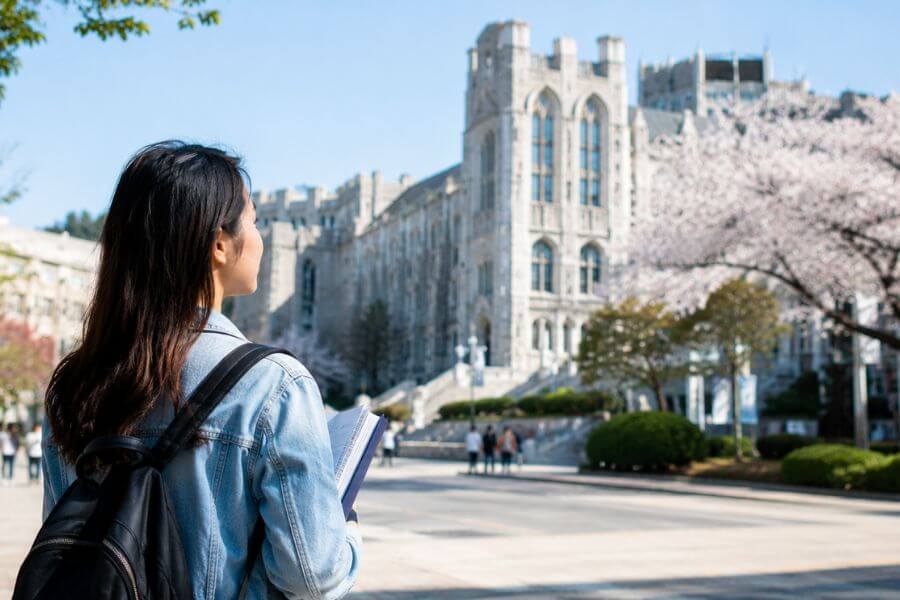
Located in the northeastern part of Seoul, Korea University is famous for its stunning, castle-like stone architecture and its deeply passionate student culture. Founded in 1905, it is one of the oldest higher education institutions in the country. The campus features beautiful gothic buildings surrounded by lush lawns, making it feel like a classic academic estate placed in the center of a bustling modern city.
The school is renowned for its business school, its law programs, and its humanities divisions. The Business School was the first in the nation to receive both AACSB and EQUIS accreditations, marking it as a truly global center for business education. If you are looking to understand global trade, marketing, or corporate strategy with an Asian focus, this campus offers incredible insights.
What truly sets this institution apart is its sense of community and school pride. The student body is remarkably tight-knit. Every year, a massive rivalry event takes place with Yonsei University, featuring intense sports matches, elaborate cheering routines, and campus-wide celebrations. This festival culture helps international students build deep bonds with their local classmates. You are not just an outside observer here; you are welcomed into the student traditions from your very first week.
The university also offers robust support structures through its global services office. They organize regular cultural excursions, provide assistance with visa paperwork, and run a dedicated global student lounge where you can study, relax, and meet peers from every continent. The surrounding neighborhood, known as Anam, is a bustling college town filled with budget-friendly restaurants, study cafes, and student housing options that cater specifically to your daily needs.
Yonsei University
Situated in the western heart of the capital, Yonsei University rounds out the famous trio. It sits in Sinchon, a vibrant neighborhood famous for being the primary student district of Seoul. Surrounded by other major campuses, Sinchon is packed with youthful energy, street performances, affordable dining, and endless social spaces.
The campus itself is exceptionally beautiful, known for its historic buildings covered in green ivy and its long, tree-lined main pathway. It is home to the Underwood International College, a division where all courses are conducted entirely in English. This college draws students from all over the world, creating a liberal arts environment within a massive, research-driven Asian university.
The institution excels in economics, global management, life sciences, and international relations. It places a strong emphasis on global engagement, maintaining student exchange partnerships with hundreds of top universities across North America, Europe, and Europe. This global focus means that the faculty is highly diverse, with many professors holding degrees from top institutions worldwide and bringing international perspectives into every lecture.
Living and learning here allows you to fully immerse yourself in the urban student lifestyle. You can finish a challenging afternoon lecture on international trade and walk straight out of the campus gates into a neighborhood alive with culture, music, and social gatherings. The university’s international house offers comfortable dormitory spaces where you can live alongside both foreign and domestic students, encouraging natural cross-cultural friendships and language practice.
Top Science and Technology Institutes
If your academic goals lean toward laboratory research, artificial intelligence, advanced engineering, or scientific innovation, the country has specialized powerhouses that rival the best technical institutes globally. These schools operate with distinct models, often providing massive financial benefits and cutting-edge facilities to attract global scientific talent.
KAIST
The Korea Advanced Institute of Science and Technology, located in the central scientific hub of Daejeon, is the nation’s premier research university for science and engineering. Established by the government in 1971 with the explicit goal of training top-tier scientists, it has played a massive role in building the nation’s high-tech industries.
The educational model here is distinct from traditional schools. Nearly all undergraduate and graduate lectures are conducted in English, removing a major barrier for global applicants. The campus sits in Daedeok Innopolis, a massive research and development district home to private corporate labs and government research centers. This location provides you with unparalleled access to internships, collaborative research projects, and direct career paths into high-tech fields.
The academic environment is rigorous and fast-paced. Students spend extensive hours in highly advanced laboratories, working on everything from robotics and semiconductor design to synthetic biology and green energy solutions. The university receives massive corporate and state funding, ensuring that you will work with the latest tools and technologies available in your field.
The school provides a highly supportive financial structure for international students. Most admitted foreign students receive full tuition waivers along with monthly stipends to cover living costs, provided they maintain a solid academic standing. The campus life in Daejeon is self-contained and serene, offering a focused environment where you can dedicate yourself fully to your scientific passions while enjoying excellent sports facilities, student clubs, and international food options.
POSTECH
Pohang University of Science and Technology sits in the coastal city of Pohang on the southeastern edge of the peninsula. Founded in 1986 by POSCO, one of the world’s largest steel producers, this private university was designed from the beginning to be a highly selective, world-class research institution with a low student-to-faculty ratio.
The student body is small, which creates an intimate and highly collaborative academic culture. You will find that professors are exceptionally accessible, often mentoring students directly on major research papers and laboratory experiments. The campus houses the Pohang Light Source, a massive synchrotron radiation laboratory that draws researchers from across the globe, providing a scientific tool that few universities in the world possess.
The academic focus is heavily geared toward material science, chemical engineering, computer science, and mechanical engineering. Because of its close relationship with industry giants, the school excels at turning academic research into practical, commercial applications. If you want to see your scientific ideas move from a laboratory bench into actual manufacturing or technology products, this school offers a direct bridge.
Living in Pohang gives you a different perspective on life outside the capital. It is a dynamic industrial and coastal city where you can enjoy beautiful beaches, fresh seafood, and a lower cost of living compared to Seoul. The university ensures that all international students have comfortable housing, intensive language support, and a welcoming community that helps you feel at home in this coastal tech hub.
Specialized Regional and Urban Powerhouses
While the major names in Seoul and the elite tech hubs get immense attention, several other universities offer top-tier education, specialized programs, and unique regional advantages. These institutions are often powerhouses in specific fields and provide excellent alternatives depending on your academic focus.
Sungkyunkwan University
With a history that traces its roots back to the historic royal Confucian academy founded in 1398, Sungkyunkwan University beautifully bridges ancient tradition with modern corporate power. Today, the university is deeply partnered with the Samsung group, which has invested massive financial resources into transforming it into a global educational leader.
The university operates across two distinct campuses. The Humanities and Social Sciences campus sits in the historic center of Seoul, near ancient palaces and traditional neighborhoods. The Natural Sciences and Engineering campus is located in Suwon, a tech-heavy city just south of Seoul. This division allows each campus to develop an environment tailored specifically to its disciplines.
Thanks to corporate backing, the Suwon campus boasts incredible modern laboratories, advanced computing centers, and specialized programs in semiconductor engineering and software development. The Seoul campus offers exceptional programs in business, East Asian studies, and global economics. The school provides extensive merit-based funding, often waiving substantial portions of tuition for international students who arrive with strong academic profiles or excellent language test scores.
Hanyang University
Hanyang University is widely recognized as the engine that drove the nation’s industrial architecture, producing a massive percentage of the engineers who built the country’s modern infrastructure. Its main campus is located in eastern Seoul, built directly over a major subway hub that connects you effortlessly to every corner of the capital.
The school is a leader in engineering, urban planning, and computer science, but it also boasts highly ranked programs in business, hospitality management, and design. The campus culture is energetic, practical, and highly focused on employability. The university runs a massive career center that organizes regular job fairs, interview preparation workshops, and networking events with major corporate recruiters.
For international students, the school offers an exceptionally welcoming environment with a vast array of English-taught courses. Their international office is well-known for its efficiency, helping you handle everything from health insurance setups to finding off-campus housing. The surrounding neighborhood is filled with affordable student housing, lively food streets, and creative spaces where you can relax after a demanding day of study.
Ewha Womans University
Founded in 1886 by American missionaries, Ewha Womans University is the world’s largest female educational institution and holds an incredibly prestigious place in history. Located in western Seoul, right next to Yonsei University, it has educated many of the nation’s most prominent female leaders, politicians, CEOs, and scientists.
While undergraduate programs are open exclusively to women, its graduate schools and international exchange programs welcome students of all genders. The campus is architectural poetry, famous for its underground campus complex that blends green parks with modern glass classrooms hidden within a dramatic valley design.
The university excels in humanities, international relations, pharmacy, and the arts. It is home to an exceptionally strong Korean language education center, making it a top choice if you want to gain high fluency in the language while pursuing your degree. The surrounding commercial district is famous for fashion, beauty salons, and trendy cafes, creating an exceptionally lively and dynamic neighborhood for student life.
Sogang University
Established in 1960 by the Society of Jesus, Sogang University is a top-tier private institution located in western Seoul. It is famous for its rigorous academic standards, its strict attendance policies, and its highly personalized approach to higher education, operating on a smaller student scale than many of its neighbors.
The school is an absolute powerhouse in business administration, economics, mass communication, and media studies. Its alumni occupy influential positions throughout the nation’s media networks, financial institutions, and corporate boardrooms. The academic environment emphasizes ethical leadership, critical analysis, and cross-disciplinary study, encouraging you to major in multiple fields to broaden your career options.
The international community here benefits from an incredibly supportive atmosphere. The school offers intensive language programs that are highly praised for their focus on spoken communication. Because the campus is compact, you can navigate between your classrooms, the library, and student lounges within minutes, fostering a tight-knit community feel in the middle of a massive global metropolis.
Comprehensive University Comparison
Choosing the right institution requires looking at multiple factors side by side. Your choice will depend on your field of study, your preferred location, and the primary language used in the classroom. The following table provides an overview of these top institutions to help you weigh your options effectively.
| Institution Name | Primary Campus Location | Standout Academic Fields | Main Language Options | Distinct Campus Attribute |
| Seoul National University | Southern Seoul | Science, Engineering, Public Policy, International Relations | Korean and English | Vast mountain campus with massive research funding |
| Korea University | Northeastern Seoul | Business, Law, Humanities, Media | Korean and English | Historic stone architecture and passionate school pride |
| Yonsei University | Western Seoul | Global Management, Economics, International Studies | English and Korean | Located in a lively student district with a major English-only college |
| KAIST | Daejeon (Central) | Advanced Engineering, Robotics, Computer Science | Primarily English | Situated in a major scientific research town with high state backing |
| POSTECH | Pohang (Southeast) | Material Science, Chemical Engineering | English and Korean | Selective student body with direct links to industrial manufacturing |
| Sungkyunkwan University | Seoul and Suwon | Semiconductors, Software, East Asian Studies | Korean and English | Deep corporate partnership providing modern tech labs |
| Hanyang University | Eastern Seoul | Mechanical Engineering, Computer Science, Business | Korean and English | Built directly on a major transit hub with a strong career network |
| Ewha Womans University | Western Seoul | Humanities, International Relations, Arts | Korean and English | Historic institution for female leadership with stunning modern design |
| Sogang University | Western Seoul | Business Administration, Media, Economics | Korean and English | Compact urban campus known for exceptional academic discipline |
The Global Korea Scholarship
If your goal is to minimize your financial burden completely, the Global Korea Scholarship is the gold standard. Funded directly by the national government through the National Institute for International Education, this program aims to foster international goodwill and build deep educational ties by covering virtually every expense you will encounter.
Comprehensive Benefits Breakdown
Winning this scholarship completely changes your educational finances. It removes the need for personal funding by providing full coverage from the moment you leave your home country until the day you graduate.
- Full Tuition Coverage: The scholarship pays for your complete tuition across your entire degree program. The government coordinates directly with your chosen university to clear all academic fees, allowing you to focus purely on your lectures and research.
- Monthly Living Allowance: Undergraduate recipients receive a steady monthly stipend of 900,000 KRW, while graduate students receive a higher allocation to support their advanced living and research needs. This money is designed to comfortably cover your food, local transit, and daily necessities.
- Airfare Support: The program covers your economy class flights. They pay for your initial flight to the country when you win the award and your return flight home once you successfully complete your degree requirements.
- Settlement and Completion Grants: Upon your first arrival, you receive a one-time settlement allowance of 200,000 KRW to help you buy bedding, kitchen supplies, or initial room setups. When you graduate and return home, you receive a final completion grant to assist with your moving transitions.
- Language Training Funding: If you do not already possess a high level of language fluency, the scholarship provides a full year of intensive language education at a dedicated institute before your degree courses start, paying all training fees entirely.
- Comprehensive Health Insurance: The scholarship includes regular health insurance coverage. This ensures you have access to medical care, clinic visits, and hospital support throughout your stay without worrying about major medical bills.
Understanding the Two Application Tracks
When you apply for this scholarship, you must choose between two distinct pathways. You cannot apply through both simultaneously, so understanding how they function is vital to your application strategy.
The Embassy Track
This pathway requires you to submit your complete application package directly to the official embassy of South Korea located in your home country. Each embassy receives a specific quota of slots allocated for citizens of that nation.
The process moves through three distinct screening stages. First, the embassy reviews all local applications and conducts interviews to choose their initial nominees. Second, these chosen profiles are sent to the central government office in Seoul for a final evaluation. Third, if you pass this central review, your documents are sent to the three universities you selected on your application form. At least one of these selections must be a regional institution outside of Seoul, encouraging a balanced distribution of international talent across the nation. You must gain acceptance from at least one of these schools to secure the final scholarship award.
This track offers a major benefit: you can select up to three different universities, giving you multiple chances to find an academic home. However, it requires you to compete directly against other top applicants from your own nation, making the initial embassy interview highly competitive.
The University Track
This pathway allows you to bypass the embassy entirely. You apply directly to a single participating university of your choice, submitting your documents straight to their international admissions office.
This track moves through two main stages. The university evaluates your application package, conducts its own internal interviews, and selects its chosen list of international nominees. These profiles are then sent to the central government office in Seoul. The central committee performs a final review to ensure you meet all national eligibility standards and financial regulations. Since you only apply to one school, you must select your institution with absolute certainty, matching your academic profile perfectly to their specific department strengths.
This track is highly advantageous if you have a specific regional school in mind, or if you are a graduate applicant who has already established a strong connection with a professor at that specific university. It simplifies your options but leaves you with no backup school choices within the scholarship program if that single institution rejects your profile.
Eligibility Criteria and Academic Standards
To maintain the high prestige of the program, the government enforces strict eligibility standards that you must verify before starting your application forms.
- Citizenship Requirements: You and both of your parents must hold citizenship in a country that is part of the official scholarship invitation list. If you or either parent holds citizenship in South Korea, you are entirely ineligible to apply.
- Age Limits: For undergraduate programs, you must be under the age of 25 by the official start date. For master’s and doctoral tracks, you must be under the age of 40, though certain academic professors from developing nations may receive an extension up to 45 years of age.
- Academic Performance: Your previous academic record must be exemplary. You need to show an overall grade point average equivalent to 80% or higher from your previous school, or rank within the top 20% of your graduating class.
- Degree History: You must hold or be on track to receive your high school diploma for undergraduate applications, or your relevant university degrees for graduate programs. You cannot apply if you have already completed an equivalent degree program inside South Korea.
University-Specific and Corporate Scholarships
If you do not secure the national government scholarship, your study abroad dreams are far from over. Individual universities and major multinational corporations offer extensive funding options that can cover substantial portions of your educational costs.
University Merit Awards
Almost every top institution has a dedicated fund to attract high-achieving international students. These awards are usually tied directly to your initial admissions application, meaning you do not always need to file separate forms to be considered.
Schools like Yonsei, Korea University, and Sungkyunkwan review your high school grades, standard test scores, and personal essays during the admissions process. Based on your academic strength, they can award tuition waivers ranging from 30% to 100% for your first semester or your first full academic year. To keep these scholarships active for subsequent semesters, you must maintain a specific grade point average, often requiring you to stay above a 3.0 or 3.5 out of a 4.5 grading scale.
The Language Proficiency Bonus
The country values its language deeply, and universities reward students who take the time to learn it. If you apply with a high score on the Test of Proficiency in Korean, known as TOPIK, you unlock massive institutional discounts.
Many universities offer immediate 50% or even 100% tuition coverage if you enter with a TOPIK Level 4, 5, or 6. Even if you start your studies in an English-taught program, earning a high language certificate during your stay can trigger financial bonuses, research grants, or housing subsidies. It serves as a clear signal to the administration that you are dedicated to integrating into the campus culture and participating fully in local academic life.
Major Corporate Foundations
Because the country’s economy is powered by massive, globally recognized family conglomerates, these corporations invest heavily in future international talent. They fund independent foundations designed to sponsor top global scholars.
- The Samsung Global Scholarship Program: This highly selective initiative targets top-tier international students pursuing graduate degrees in computer science, semiconductor engineering, and global business administration. It covers full tuition and provides housing along with a guaranteed career path at the company upon graduation.
- The Hyundai Motor Chung Mong-Koo Foundation: This foundation provides robust financial backing to exceptional students from developing countries who are pursuing degrees in engineering, future mobility, and business management at elite universities. It covers your full tuition, provides monthly living costs, and organizes regular mentoring events.
- The POSCO TJ Park Foundation: Focused on fostering future leaders across Asia, this foundation supports international graduate students studying science, engineering, and Korean studies at partner universities. It offers full tuition waivers and comprehensive monthly stipends for up to two years.
Scholarship Options Matrix
Navigating the landscape of financial support requires knowing the exact scope of what each award provides. The following table details the primary funding options, showing exactly what expenses they cover and who can apply.
| Scholarship Program Name | Funding Source | Tuition Coverage Scope | Monthly Stipend Provided | Flights Included | Target Applicant Profile |
| Global Korea Scholarship | National Government | 100% Full Waiver | Yes (Comprehensive) | Yes (Round-Trip) | Exceptional global students across all degree levels |
| SNU Global Scholarship | Seoul National University | 50% to 100% Waiver | Yes (Select tracks) | No | Admitted international students with top academic profiles |
| Underwood International College Award | Yonsei University | 50% to 100% Waiver | No | No | Applicants entering the English-medium liberal arts college |
| KAIST International Award | Institutional Fund | 100% Full Waiver | Yes (Based on GPA) | No | Science and engineering students maintaining solid grades |
| Samsung Global Program | Corporate Foundation | 100% Full Waiver | Yes (High Stipend) | Yes | Graduate tech and business students seeking corporate careers |
| Chung Mong-Koo Fellowship | Hyundai Foundation | 100% Full Waiver | Yes (Comfortable) | No | ASEAN and developing nation scholars in engineering fields |
| TOPIK Excellence Award | Various Universities | 30% to 100% Waiver | No | No | Applicants possessing high certified Korean language levels |
Step-by-Step Application Process
Securing your spot at a top university or winning a major scholarship requires a meticulous approach to documentation and timing. The application landscape is competitive, and missing a single detail can delay your plans by half a year.
Preparing Your Document Portfolio
Months before the application portals open, you must act as a careful archivist, gathering and validating every piece of paper required by admissions committees.
First, you need official copies of your academic transcripts and graduation diplomas. These cannot simply be printed from a school portal; they must carry international legal weight. You will need to get these documents apostilled or consular-confirmed by the Korean embassy in your home country. This process proves to the university registry that your previous education is entirely authentic.
Second, you must craft an exceptional personal statement and a detailed study plan. This is your primary opportunity to speak directly to the professors. Instead of using vague language about loving the local pop culture, focus your essays on specific academic goals. Explain why a particular department matches your research interests, how you plan to navigate the language barrier, and what you intend to achieve in your career after graduation.
Third, you must secure strong letters of recommendation. Choose professors or academic supervisors who know your work intimately and can write detailed descriptions of your analytical skills, your work ethic, and your ability to adapt to new environments. Give your recommenders plenty of time, and provide them with a summary of your achievements so they can write highly specific, impactful letters.
Tracking the Semiannual Admissions Timeline
The country’s academic calendar operates on a different rhythm than Western systems. The primary academic year begins in the spring, during the beautiful cherry blossom season of March, while a secondary intake occurs in the fall semester of September.
For the Spring Intake (March Start)
The preparation process starts nearly a year in advance. By May and June, you should be finalizing your university selections and taking your language proficiency exams.
When August arrives, official university application portals open their online systems. You will spend August and September filling out digital forms, paying application fees, and mailing your physical, apostilled document packages directly to the admissions offices in Seoul or other regional hubs. Throughout October and November, university departments perform their reviews and conduct online interviews via digital video platforms. By December, final admission letters are issued, allowing you to spend January and February securing your student visa and booking your flights.
For the Fall Intake (September Start)
If you prefer to start your studies later in the year, your timeline shifts to the winter months. You will spend November and December gathering your transcripts and drafting your research statements.
The application portals open their digital gates during February and March. You must submit your materials promptly, ensuring all physical documents arrive at the campus registries before the tight spring deadlines close. Interviews take place throughout April and May, with final acceptance results arriving in June. This gives you July and August to pack your bags, clear your visa checks, and find your local housing options before the autumn semester begins.
Cost of Living and Budgeting
While tuition is a massive part of your financial equations, your daily living costs will determine your comfort and stability throughout your study abroad experience. Managing your funds wisely ensures you can enjoy your time without constant financial pressure.
Accommodation Expenses
Where you sleep will be your single largest recurring monthly expense. You have several distinct choices, each balancing privacy, cost, and location differently.
- On-Campus Dormitories: This is often the most sensible choice for your first semester. Dormitories charge between 250,000 KRW and 600,000 KRW per month, depending on whether you share a room with a roommate or secure a private space. This fee usually includes high-speed internet and utility costs, and places you steps away from your morning lecture halls.
- Goshiwon (Micro-Rooms): If you are on a very tight budget and want your own private space, these tiny, single-occupancy rooms are scattered all around university districts. Costing between 200,000 KRW and 450,000 KRW monthly, they provide a bed, a desk, a small fridge, and a private bathroom. Utilities are included, and the landlords often provide complimentary white rice, kimchi, and instant noodles in a shared kitchen.
- One-Room Apartments: For complete independence, you can rent a standard studio apartment off-campus. These spaces require a substantial security deposit, known locally as “bojeunggeum,” which often ranges from 5,000,000 KRW to 10,000,000 KRW. Monthly rent generally runs between 450,000 KRW and 800,000 KRW, plus separate utility bills for electricity, heating, and water.
Food and Daily Sustenance
The food culture here is incredible, and your monthly grocery budget can vary widely depending on your cooking habits and lifestyle choices.
If you enjoy eating out, university cafeterias provide highly nutritious, well-balanced traditional meals for around 4,000 KRW to 7,000 KRW per plate. Neighborhood restaurants, especially in student districts, offer hearty stews, rice bowls, and noodle dishes for 7,000 KRW to 12,000 KRW.
If you prefer to cook at home, purchasing local ingredients at traditional street markets is far more economical than shopping at massive westernized grocery stores. Focus your diet on seasonal vegetables, local eggs, tofu, and pork cuts, which remain highly affordable. A realistic monthly food budget for a student balances cooking at home with casual dining out, totaling roughly 400,000 KRW to 600,000 KRW.
Transit, Connectivity, and Utilities
Navigating the cities is efficient, and keeping your digital devices connected is straightforward, provided you understand the local networks.
Public transportation relies on a unified smart card system called T-money. You can tap this card on buses and subways, with base fares starting around 1,400 KRW per trip. The system allows free transfers between lines within a specific time window, keeping a monthly transit budget around 60,000 KRW to 90,000 KRW even if you commute daily.
For your phone and internet, you will need a local SIM card linked to your Alien Registration Card. Monthly prepaid or postpaid data plans offering generous high-speed data buckets cost between 35,000 KRW and 60,000 KRW. If you live off-campus, utility bills fluctuate with the seasons: summer air conditioning and winter floor heating can add 50,000 KRW to 150,000 KRW to your monthly expenses depending on your usage habits.
Campus Life and Cultural Integration
Stepping beyond your academic work, your personal growth will be shaped by how deeply you engage with the local culture and your fellow students on campus.
Joining Student Clubs
The university experience here is famous for its vibrant club culture, known locally as “dongari.” These student-run organizations span every imaginable interest, from traditional acoustic music and modern dance to robotic engineering, mountaineering, and photography.
Joining a club is the fastest path to building genuine friendships with local students. It breaks down cultural barriers quickly because you share a common passion. The clubs often host regular gatherings, weekend trips, and late-night dinners where you can practice your conversational language skills in a completely relaxed environment. Do not be shy about attending their recruitment booths during the first week of the semester; most clubs are eager to welcome international perspectives.
Navigating the Language Barrier
While top universities offer numerous courses taught entirely in English, living your daily life requires a basic grasp of the local tongue. Learning the alphabet, known as Hangul, is something you can achieve in a matter of hours, as it is a highly logical phonetic system.
Being able to read signs, order food at neighborhood restaurants, and say basic greetings will dramatically alter how locals interact with you. Shop owners and restaurant staff appreciate whenever an international student makes an effort to speak the language, often rewarding you with extra portions of food or helpful directions. Most universities offer free or low-cost evening language classes for their exchange and international students, providing an excellent structured path to build your confidence.
Exploring Beyond the Capital
It is easy to get caught up in the bright neon lights and endless energy of Seoul, but the peninsula holds incredible treasures outside of the capital zone. Taking time during your weekends or semester breaks to travel regionally will deepen your understanding of your host country.
You can board the high-speed KTX train and reach the southern port city of Busan in less than three hours, experiencing a completely different coastal culture, beautiful beaches, and unique regional dialects. Visit Gyeongju, the ancient capital of the Shilla Kingdom, to walk among historic burial mounds, ancient temples, and outdoor archaeological treasures. Explore the mountainous province of Gangwon for winter skiing and breathtaking national park hikes, or take a short flight to Jeju Island to see volcanic landscapes and unique seaside communities.
Frequently Asked Questions
What is the minimum TOPIK score required to study at a top university?
For programs taught primarily in the local language, most top institutions require a minimum score of TOPIK Level 3 or Level 4 for undergraduate admission. For highly competitive majors like business administration or media studies, reaching a Level 5 or Level 6 is strongly recommended to ensure your academic success. If you are applying to an English-medium track or an international college, a TOPIK score is not mandatory for admission, though possessing a basic level still helps your general visa processing and scholarship evaluation.
Can international students work part-time jobs while studying?
Yes, you can work part-time, but you must follow strict legal procedures. Once you hold a valid D-2 student visa and have completed at least one semester of study, you can apply for official part-time work permission through your university’s international office and the immigration bureau. The number of hours you can work generally ranges from 20 to 30 hours per week during the regular semester, depending on your language proficiency level. Students with higher TOPIK scores receive permission for more flexible hours, while vacation periods usually allow full-time employment without hour restrictions.
How do I handle medical needs and health insurance during my stay?
The government requires all international students staying on a long-term student visa to enroll automatically in the National Health Insurance Service. This national plan requires a monthly premium payment, which is heavily discounted for international students. The insurance covers a substantial portion of your medical costs, allowing you to visit local neighborhood clinics, dental centers, and major hospitals for consultations, prescription medications, and emergency care at highly affordable rates.
Are there any gender restrictions for applying to Ewha Womans University?
For regular undergraduate degree programs, admission is open exclusively to female applicants, keeping with the school’s historic foundation. However, their graduate schools, global summer semesters, and international exchange programs welcome students of all genders. If you are a male student looking to experience their world-class campus environment, you can easily do so by applying through an exchange program partnership via your home university or enrolling in their intensive language institute.
What is the main difference between the Embassy Track and the University Track for the GKS?
The main difference lies in your application route and the number of university choices you receive. The Embassy Track requires you to apply through the local embassy in your home country, allowing you to select up to three different universities on your forms, which must include at least one regional school. The University Track requires you to send your application straight to a single institution of your choice, giving you only one school option within that application cycle but allowing a direct connection with that specific campus admissions team.
Is it difficult to find English-taught programs outside of the engineering fields?
While engineering and natural sciences boast the highest percentage of English-taught courses, top institutions have expanded their English offerings across many disciplines. You will find complete undergraduate and graduate degrees conducted entirely in English within international studies, business administration, global economics, and specialized liberal arts divisions like Yonsei’s Underwood International College. Always review the detailed course catalog of your chosen major before applying to ensure the department offers enough English lectures to meet your degree tracking needs.
What happens if I fail to maintain my GPA requirements for a scholarship?
If your academic performance drops below the specific threshold set by your university or the scholarship foundation, you will usually receive an official warning period. For many university merit awards, falling below the required grade point average results in a temporary suspension of your tuition waiver for the following semester. Once you bring your grades back up to the required standard, the financial support is typically restored. For strict programs like the Global Korea Scholarship, repeated semesters of poor academic standing can result in a permanent cancellation of your funding.
How do I secure housing if I do not get a spot in the university dormitory?
If you miss the dormitory application deadline or prefer an off-campus lifestyle, you can explore the surrounding university neighborhood. Finding a local goshiwon or micro-room can be done quickly after arrival without long-term commitments or large deposits. If you wish to secure a standard studio apartment, it is highly recommended to work with a licensed local real estate agent, known as a “budongsan,” located near your campus. They can show you multiple properties, help negotiate your rental deposit, and ensure your lease contract is legally registered and secure.