Key Takeaways
- The Residence Card, formerly known as the Alien Registration Card (ARC), serves as your primary identity document and is mandatory for most long-term services.
- You generally need a physical phone number registered to your name to open a standard bank account and access mobile verification services.
- Most banks require you to visit a branch in person, especially for your first account, to lift initial transaction limits.
- A postpaid mobile plan is superior for long-term residents because it allows you to use the mandatory identity verification systems required for most apps and websites.
- Always bring your original passport and your Residence Card to every appointment, as digital copies are rarely accepted for initial registration.
- Select a bank branch near your home or workplace to increase your likelihood of success and receive more personalized support.
Welcome to Your New Life in South Korea
Moving to a new country is a whirlwind of emotions. You are likely dealing with the stress of packing, the excitement of exploring a new culture, and the practical demands of setting up a functional daily life. In South Korea, life revolves around digital connectivity and a robust banking system. If you want to navigate your stay without constant roadblocks, you must secure two essential items as soon as possible: a local mobile phone number and a local bank account.
These two services are deeply linked. In the Korean digital ecosystem, your phone number acts as your secondary identity. When you try to sign up for a delivery app, a shopping site, or even a local government portal, the system will ask to verify your identity. This process almost always triggers a text message to a phone number registered specifically to your name. If you do not have this, you will find yourself locked out of many digital conveniences. Similarly, your bank account is the hub for your rent, utility bills, and salary deposits. Understanding how to bridge these requirements is the key to living comfortably.
The Foundation: Understanding the Residence Card
Before you can approach a bank or a mobile carrier, you must have your Residence Card. This card is your official ID in the country. Without it, you are limited to very basic prepaid services that often do not provide the identity verification capabilities you need for long-term living.
The application for this card starts at the local immigration office. Once you arrive in Korea, you should prioritize scheduling an appointment through the official government portal. The wait times can be significant, so do not delay this step. Once you submit your application and your fingerprints, you will receive a receipt. While this receipt serves as proof of your legal status, it is not a substitute for the physical card when you visit banks or mobile service providers. You must wait for the actual card to be printed and delivered or collected.
Choosing and Registering for a Mobile Phone Number
Mobile services in Korea are categorized into two main types: prepaid and postpaid. Many new arrivals mistakenly opt for long-term prepaid plans because they seem simple to obtain. However, if you are planning to stay for a year or more, you should aim to transition to a postpaid plan as quickly as your status allows.
Comparing Mobile Plan Options
| Feature | Prepaid Plans | Postpaid Plans |
| Requirement | Passport only | Passport + Residence Card |
| Verification | Basic functionality | Full ID verification (PASS app) |
| Cost | Paid upfront | Monthly billing |
| Flexibility | High | Contract-based |
| Best For | Short-term visitors | Long-term residents |
To get a postpaid number, visit an official carrier shop. The three major providers are SK Telecom, KT, and LG U+. These companies also have smaller “budget” carriers that use the same network infrastructure but at a lower price point. When you visit the store, bring your passport and your Residence Card. Inform the clerk that you want a plan that allows for “identity verification” (called bon-in-in-jeung). This is the magic phrase that ensures your phone number is linked to your government records.
Preparing for Your Bank Visit
Once you have your phone number, the path to opening a bank account becomes much clearer. Most banks in Korea will not open an account for you without a phone number registered to your own name. Furthermore, you must visit a physical branch. While some digital-only banks exist, they often have strict requirements for foreigners, and having a traditional bank with a branch near your home is usually more beneficial for solving potential future issues.
Documents to Bring to the Bank
- Original Passport: This is non-negotiable. Ensure it is valid and undamaged.
- Residence Card: This proves your legal residency and allows the bank to verify your tax information.
- Korean Phone Number: Have this active and ready, as the teller will send a verification code to it.
- Proof of Employment or Enrollment: If you are here for work or school, bring a certificate of employment or a student ID. This helps the bank understand the purpose of your account and may help in lifting initial transaction limits.
- Proof of Address: A copy of your housing contract or a utility bill can sometimes be requested, so keep these in your folder just in case.
Navigating the Branch Experience
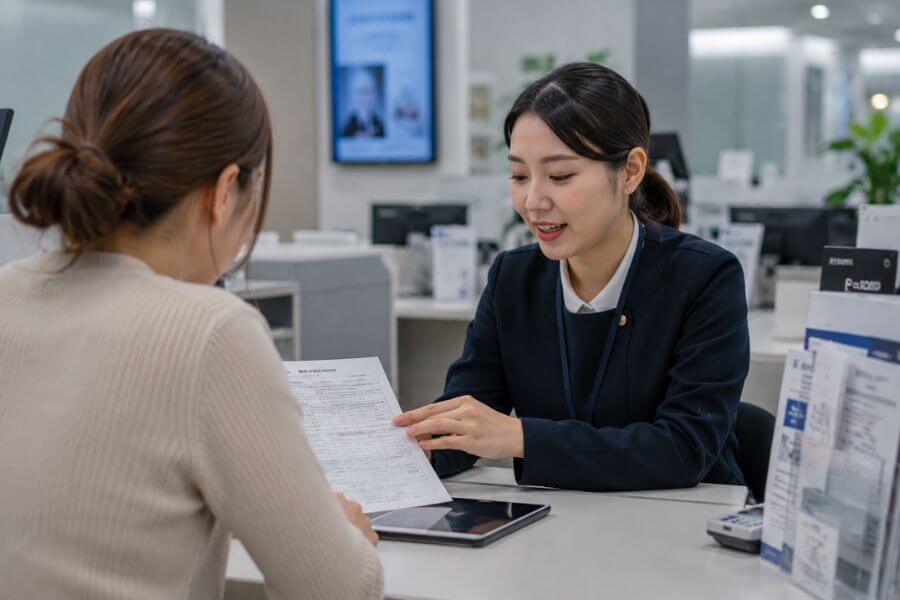
Walking into a Korean bank can feel intimidating, but the process is standardized. When you enter, look for a ticket machine. You will usually press a button for “new account” or “general services.” Wait for your number to be called, then approach the desk with your folder of documents.
Be prepared for the “account limit” rule. To prevent financial fraud, new accounts for foreigners are often classified as “limited-use” accounts. This means you may be restricted to a daily transfer limit of 300,000 KRW. Do not let this frustrate you. It is a standard security measure. Once you have documented proof of your regular income or rent payments, you can return to the bank to request that they remove these limits. It is a routine request for the staff, so simply be polite and provide the requested evidence of your financial activity.
Managing Your New Financial Tools
After you receive your bankbook (the traditional paper record) and your debit card, take a moment to set up your mobile banking app. Most major banks offer excellent apps that are available in English. This is where you will manage your money, check your balance, and make transfers.
If you find yourself stuck, remember that Korean bank staff are generally very helpful, though their English proficiency varies by location. If you are in a large city like Seoul or Busan, look for branches in major business districts; these are more accustomed to assisting international residents and often have staff members who speak English or have dedicated materials for foreigners.
Frequently Asked Questions
Do I really need a Korean phone number to open a bank account?
In almost all cases, yes. The banking system requires a phone number to send verification codes for your initial account setup and for ongoing security. Since this number must be tied to your legal identity, you need a postpaid plan connected to your Residence Card.
Can I use a hotel address to open my account?
Banks generally require a verifiable residential address. A hotel or guesthouse is usually not considered a permanent enough residence for the banking system’s requirements. Use your long-term housing contract or your official school dormitory address.
What is the difference between a Residence Card and an ARC?
They are the same thing. The government officially renamed the Alien Registration Card to the Residence Card in 2024. You may still hear people call it an “ARC” in conversation, but all documentation and official systems now refer to it as the Residence Card.
How do I increase my daily bank transfer limit?
After you have used your account for a few weeks or months, you can visit your bank branch again. Bring proof of your salary or your rent contract. Ask the teller to “lift the account restriction” (han-do-je-han-hae-je). They will review your account history and, provided you have a legitimate reason, they will increase your limit.
Are there any banks that are better for foreigners?
Some of the larger national banks have more experience with international residents. Banks like Shinhan, KB Kookmin, and Hana are often cited by the expat community for having better English-language support and more robust systems for handling foreign documentation. However, the specific staff at your local branch will play the biggest role in how smooth your experience is.