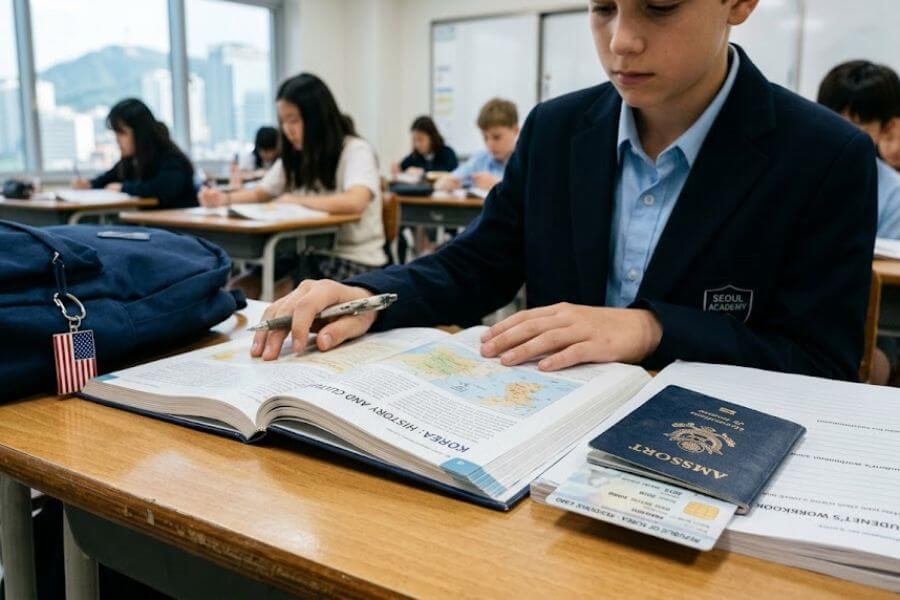
Moving your family across the world to Seoul is a grand adventure filled with bright city lights, beautiful mountain trails, and delicious food. One of your biggest tasks will be finding the right school for your children where they can keep up with their American studies while learning about their new home. Seoul has some of the finest learning centers in Asia, but the enrollment process and the financial costs require careful preparation. This guide will walk you through everything you need to know about setting up your children for academic success in the South Korean capital.
Understanding the Legal Requirements for Enrollment
Before you look at campus maps or check out science labs, you must know if your children are legally eligible to attend an international school in South Korea. The government has strict rules about who can sign up for these campuses. These rules ensure that the schools serve families who truly need an international education.
The Passport Rule
To get a seat at one of these top-tier academies, your child must hold a non-Korean passport. As an American family, your children will meet this requirement through their United States citizenship documents. If your child holds dual citizenship with South Korea and the United States, the rules can get a bit more complicated. You will need to show that your child has lived outside of South Korea for a specific amount of time.
The Time Abroad Rule
If a student holds a South Korean passport, they can only enroll if they have lived outside of South Korea for at least three full years. That means thirty-six months of documented residency in another country like the United States. Some schools require even more time, stretching up to five years, depending on their individual campus policies.
Visa Types and Documentation
Your family must have the correct legal status to reside in the country. Most American families moving to Seoul carry specific corporate or government visas. Here are the most common types:
- E-7 Visas: These are for foreign professionals, engineers, and corporate executives who are hired by companies based in Seoul.
- F-4 Visas: These are special visas for individuals of Korean descent who are returning from overseas.
- A-2 Visas: These are designated for government officials and military families who are stationed on local bases.
You must provide your Alien Registration Card, which is now officially called the Residence Card, as part of your final paperwork packet.
Top International Schools in Seoul for American Families
Seoul hosts several major campuses that align perfectly with the United States educational system. Choosing the right one depends on where you plan to live, how old your children are, and whether you want a traditional neighborhood school feel or a sprawling campus experience.
Yongsan International School of Seoul
Located right in the heart of the central foreign district near Itaewon, this campus is highly popular among American families. It offers a complete American curriculum with a wide selection of Advanced Placement courses for older students. The central location means your children will not have to spend hours on a bus every morning if you live in downtown neighborhoods.
Korea International School
This academy has two main campuses. The primary school sits in southern Seoul, while the larger middle and high school campus is located just outside the city line in a tech-focused neighborhood called Pangyo. It uses a modern American curriculum that focuses on design thinking, engineering, and collaborative projects. It is an excellent match for students who love technology and hands-on science experiments.
Seoul International School
Situated on the southern border of the city, this institution is known for its rigorous academic culture. It follows a traditional United States calendar and curriculum, preparing students thoroughly for top-tier American colleges. The school has a reputation for high test scores and a strong focus on speech, debate, and musical arts.
Seoul Foreign School
This is one of the oldest international campuses in all of Asia, located in a scenic, hilly neighborhood in western Seoul called Yeonhui-dong. While it offers a British track and the International Baccalaureate program, it also has a dedicated American curriculum track that leads to a traditional United States high school diploma. The campus feels like a small university, complete with professional theaters and immense sports fields.
The Academic Year and Curriculum Choices
When you move your children to Seoul, you do not have to worry about them falling behind their peers back home. The major campuses ensure that the transition into a South Korean classroom feels familiar.
The United States School Calendar
The schools listed above operate on a standard American schedule. Classrooms open their doors in late August and finish the first half of the year in mid-December. After a winter break that lasts about three weeks, students return in early January and wrap up the school year in early June. This makes it simple to coordinate summer trips back to visit grandparents or attend American summer camps.
Grading Scales and High School Credits
Your children will earn grades on a standard A-to-F scale, and their grade-point averages will calculate exactly the same way they do in the United States. High school students earn credits that transfer directly back to American school districts if your family decides to move back across the ocean before graduation.
Course Selection and Extracurricular Activities
The academic options mirror what you would find at an excellent private academy in New England or California. Students study American history, world history, English literature, and algebra. The campuses also offer sports and clubs that match American traditions, including:
- Varsity Sports: Basketball, soccer, volleyball, cross-country running, and swimming.
- Creative Clubs: Model United Nations, student council, yearbook design, and jazz band.
- Language Classes: Every school offers intensive Korean language classes, alongside options like Spanish, French, or Mandarin Chinese.
Upfront Application and Registration Costs
Enrolling your children in these institutions requires a significant financial investment before they ever sit down at a desk. You must plan for several one-time payments during the early stages of the application process.
The Application Review Fee
When you submit your child’s initial paperwork, you must pay a non-refundable application fee. This money pays for the admissions team to review your child’s past report cards, standard test scores, and teacher recommendations. It also covers the cost of entrance exams that your child will take on campus. This fee usually runs between 300,000 Korean Won and 500,000 Korean Won per child.
The New Student Registration Fee
Once the admissions director sends you an official acceptance letter, you must secure your child’s seat by paying a registration fee. This is a one-time payment that applies only to new students entering the school system. It is non-refundable and ranges from 400,000 Korean Won to as high as 4,000,000 Korean Won depending on the specific campus rules.
The Capital Development Fee
This fee is unique to international schools and pays for building repairs, classroom remodeling, and the construction of new campus facilities. Some schools charge a large one-time amount when your child first enters the school, while others charge a smaller amount every year that your child remains enrolled. This fee can range from 4,000,000 Korean Won to 4,500,000 Korean Won for new arrivals.
Annual Tuition Structure and Currency Splitting
The largest part of your educational budget will go toward annual tuition. One unique detail about South Korean international school tuition is that many campuses split the bill into two different currencies. You must pay one portion in Korean Won and the other portion in United States Dollars.
Why Schools Split the Bill
Campuses split their tuition payments because they have expenses in both currencies. They use the Korean Won portion to pay local utilities, maintain the campus grounds, and pay local staff members. They use the United States Dollar portion to purchase American textbooks, pay for online learning software based in America, and recruit certified teachers directly from the United States.
Tuition Costs by Grade Level
Tuition costs almost always increase as your child grows older. High school students require specialized laboratory equipment, advanced textbooks, and college counseling services, which makes their classes more expensive than early childhood programs.
Here is a comprehensive breakdown of typical annual tuition rates across major Seoul international campuses for the current academic cycle:
| Grade Grouping | Korean Won Portion (Annual) | United States Dollar Portion (Annual) | Estimated Combined Total (USD) |
| Kindergarten and Preschool | 18,850,000 to 23,650,000 Won | $4,200 to $12,500 USD | $18,000 to $30,000 USD |
| Elementary School (Grades 1-5) | 21,000,000 to 26,000,000 Won | $4,200 to $14,000 USD | $20,000 to $33,000 USD |
| Middle School (Grades 6-8) | 28,450,000 to 37,000,000 Won | $4,200 to $14,000 USD | $25,000 to $41,000 USD |
| High School (Grades 9-12) | 28,450,000 to 42,000,000 Won | $4,200 to $14,000 USD | $26,000 to $45,000 USD |
Additional Hidden and Secondary Campus Fees
The base tuition rate does not cover everything your child needs during the year. When budgeting for an international school education in Seoul, you must keep these extra fees in mind so you do not face any surprises mid-semester.
School Bus Transportation
Seoul is a very large city, and traffic can be slow during the morning rush hour. Most international schools operate their own fleet of private yellow school buses that pick up students from major foreign residential neighborhoods. Using this service is optional, but it provides a safe commute for your kids. The annual cost for the bus service ranges from 1,500,000 Korean Won to 3,300,000 Korean Won per child.
The Campus Technology Fee
Almost every school requires a technology fee to keep classrooms updated with modern computers, high-speed wireless internet, and digital projectors. This fee also pays for the software subscriptions students use for their homework assignments. You can expect to pay between 300,000 Korean Won and 800,000 Korean Won annually for this service.
English Language Support Services
If your children need extra help adjusting to academic English, or if they are dual-citizens who have spent most of their lives speaking Korean, they might need to enter an English Language Learner program. These programs require specialized teachers who work with students in small groups. The fee for this extra academic support is usually around 2,500,000 Korean Won per year.
Uniforms and School Supplies
Most American-style schools in Seoul require students to wear matching uniforms. You will need to buy polo shirts, sweaters, slacks, and skirts from the official school supplier. A full set of school clothing usually costs around 300,000 Korean Won to 500,000 Korean Won. You will also need to pay separate fees for school lunches, which cost about 5,000 Korean Won to 8,000 Korean Won per day, as well as fees for overnight class trips and high school graduation ceremonies.
Step-by-Step Enrollment Guide for Parents
The process of moving your child from an American school district into a Seoul international school takes time. You should start gathering documents at least six months before you plan to move across the ocean.
Step 1: Collect Academic Records
Request official transcripts from your child’s current school. You will need full report cards for the last two to three years. If your child has taken any standard state tests, make sure to include those results in your files.
Step 2: Obtain Teacher Recommendations
Admissions offices in Seoul want to know about your child’s behavior and personality. You will need to ask your child’s current English and mathematics teachers to fill out official recommendation forms. The teachers will send these forms directly to the admissions office in Seoul.
Step 3: Legalize Your Documents
South Korea requires foreign documents to be legally verified. You must get your child’s birth certificate and your family’s official school records stamped with an Apostille certificate. This is a special stamp issued by your local state government office in America that proves the documents are authentic.
Step 4: Submit Online Applications
Fill out the electronic forms on the website of your chosen school. Upload all your stamped documents, passport photos, and visa paperwork. You must pay the application fee at this stage to move your file forward.
Step 5: Schedule Entrance Testing
If your child’s paperwork looks good, the school will invite them to complete an entrance examination. If your family is still living in the United States, many schools will allow your child’s current school principal to proctor the exam in America. The test checks your child’s reading comprehension, writing skills, and math abilities.
Step 6: Complete the Family Interview
The final step is an interview with the principal or admissions director. This conversation helps the school ensure that your family values match the school culture. Once the interview is complete, you will receive a decision within a few weeks.
Comparing Your Options at a Glance
To help you visualize your choices, look at this breakdown of the primary American-style campuses in the region. This outlines what makes each option distinct for your family budget and lifestyle.
| School Name | Primary Curriculum Type | Location in Seoul | Key Cost Distinctiveness |
| Yongsan International School | American with AP Courses | Central District (Yongsan) | Split currency billing, central location reduces bus fees |
| Korea International School | American and Design Focused | Southern District and Pangyo | High school tuition leans toward the upper price tier |
| Seoul International School | Traditional American Academic | Southern Border (Seongnam area) | Standard registration fee is higher for new students |
| Seoul Foreign School | American and IB Tracks | Western District (Seodaemun) | Highest overall tuition fees but offers immense campus facilities |
Adjusting to School Life in South Korea
Once the fees are paid and the uniforms are hanging in the closet, the real fun begins. Moving to an international school in Seoul opens up an incredible world of cultural experiences for your kids.
Meeting a Global Student Body
Even though these schools follow an American curriculum, your children will share their lunch tables with classmates from all over the globe. They will make friends with kids from Canada, Australia, Europe, and Asia. This diverse environment helps children develop a global perspective and teaches them to respect different cultures from a young age.
Learning the Local Culture
The schools do an excellent job of connecting students with the community around them. Your children will take field trips to ancient palaces in downtown Seoul, try out traditional Korean pottery making, and participate in local charity events. They will get to celebrate American holidays like Thanksgiving alongside Korean holidays like Chuseok, which is the traditional autumn harvest festival.
Handling the Academic Expectations
Schools in South Korea tend to have a strong focus on study habits and academic performance. Your children might find that they have a bit more homework than they did in their neighborhood school in America. The teachers are incredibly supportive, however, and they offer plenty of after-school help to ensure every student feels confident and capable.
Frequently Asked Questions
Can my child enter an international school in Seoul if they do not speak Korean?
Yes, your child does not need to know any Korean to enroll in these schools. All classes, assemblies, and school activities are conducted entirely in English. The only time your child will hear Korean is during their designated world language class periods. The school staff, signs around the building, and emails sent home to parents are all in English.
What happens if we move to Seoul in the middle of the school year?
Most international schools in Seoul offer rolling admissions, which means they accept new students throughout the year if they have open seats available. If a seat is open in your child’s grade level, they can start classes within a few weeks of your arrival in the country. Your tuition bill will be prorated, meaning you will only pay for the specific months your child actually attends classes.
Are school lunches included in the annual tuition cost?
School lunches are not included in the standard tuition price. Parents must deposit money into an electronic school account, and students scan their student ID card at the cafeteria register each day. The cafeteria menus are diverse, offering both western options like pasta and burgers alongside healthy Korean choices like rice, grilled meats, and soup.
Do these schools provide support for children with special learning needs?
Yes, most major international campuses in Seoul employ dedicated learning support teachers and counselors. They can accommodate mild learning differences, such as dyslexia or attention deficit differences. However, because these schools have limited resources compared to large American public school districts, you must share your child’s current educational plans with the admissions office early to make sure the school can meet their specific needs.
How do students typically commute to campus if they live far away?
The vast majority of students ride the official school bus service. The buses cover almost every neighborhood where foreign families choose to live in Seoul. Each bus has a professional driver and an adult monitor who ensures that children remain safely seated with their seatbelts buckled during the ride. Older students who live close to central neighborhoods sometimes take the clean, modern Seoul subway system or get dropped off by their parents.
Is the capital development fee refunded if our family leaves South Korea early?
No, the application processing fee, the new student registration fee, and the capital development fee are completely non-refundable. Even if your company transfers your family back to the United States after just one semester, the school will keep these funds. This is why it is vital to calculate your moving timeline carefully before finalizing your school choices.