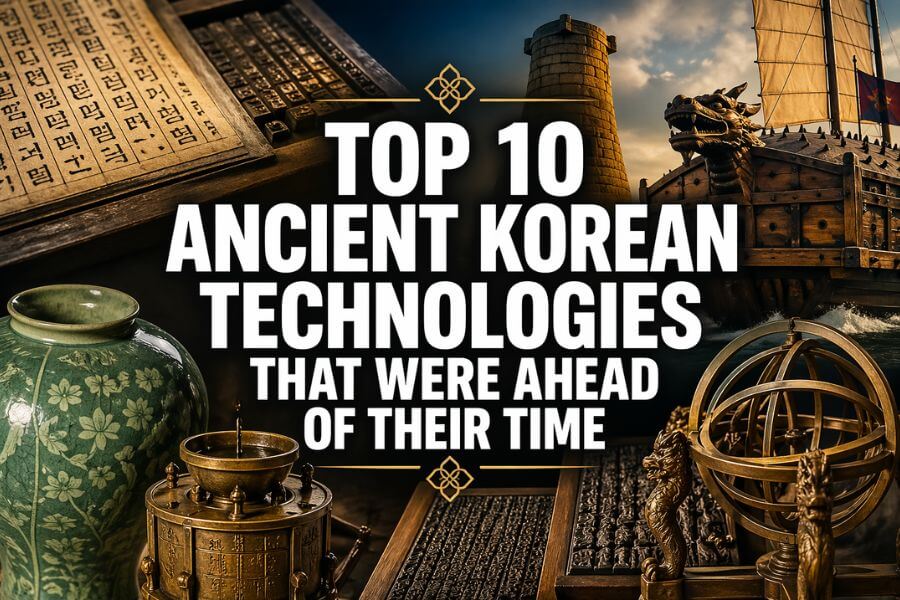
When you think about advanced technology, you might imagine modern computers, smartphones, or space travel. But what if you discovered that many groundbreaking ideas already existed hundreds or even thousands of years ago in Korea? As you explore Korean history, you will find that ancient inventors were far ahead of their time, creating tools and systems that shaped not only Korea but also influenced the world. In this article, you will discover ten amazing ancient Korean technologies that prove innovation is not just a modern idea. These inventions show how creativity, problem solving, and scientific thinking have deep roots in Korean culture.
1. Metal Movable Type Printing
You might think the printing revolution started in Europe, but Korea developed metal movable type long before that. During the Goryeo Dynasty, Korean artisans created metal blocks for printing books efficiently. This allowed texts to be reproduced faster and more accurately than woodblock printing. It helped spread knowledge, education, and culture across society. One famous example is the book Jikji, printed in 1377, which is the oldest surviving book made with metal movable type.
- Faster book production
- More accurate text reproduction
- Improved access to education
2. Ondol Underfloor Heating System
If you enjoy warm floors during winter, you can thank ancient Korea for that idea. The ondol system heats homes by sending warm air from a kitchen fire under the floor. This method keeps rooms warm for a long time and is energy efficient. You still see this technology today in modern Korean homes, showing how smart and practical the original design was.
- Energy-efficient heating
- Even heat distribution
- Comfortable living environment
3. Cheomseongdae Observatory
Built during the Silla Kingdom, Cheomseongdae is one of the oldest surviving observatories in the world. It allowed astronomers to observe the stars and predict weather patterns. This was important for farming and planning daily life. The structure itself is carefully designed with symbolic and scientific meaning, reflecting advanced knowledge of astronomy.
- Early study of stars and planets
- Weather prediction
- Support for agriculture
4. Turtle Ship (Geobukseon)
The turtle ship is one of the most famous Korean military inventions. Designed during the Joseon Dynasty, it was an armored warship used by Admiral Yi Sun-sin. The ship had a covered deck to protect soldiers and spikes to prevent enemy boarding. It also featured cannons, making it one of the earliest examples of an ironclad warship.
- Armored protection
- Advanced naval warfare design
- Effective against enemy attacks
5. Rain Gauge (Cheugugi)
Measuring rainfall may seem simple today, but Korea was the first country to invent a standardized rain gauge in 1441. Called Cheugugi, it helped farmers and officials understand rainfall patterns and improve crop production. This invention shows how science was used to solve real-world problems.
- Accurate rainfall measurement
- Better farming decisions
- Early scientific data collection
6. Water Clocks (Jagyeongnu)
Before modern clocks, keeping time was a challenge. Korea developed water clocks that automatically measured time using flowing water. The Jagyeongnu even included moving figures that rang bells at certain times. This invention combined engineering, design, and creativity.
- Automatic timekeeping
- Mechanical innovation
- Used in royal courts
7. Hangeul Writing System
While not a machine, Hangeul is one of the most scientific writing systems ever created. Developed in the 15th century under King Sejong, it was designed to be easy to learn and use. Each letter reflects the shape of the mouth when speaking. This made literacy more accessible to common people, not just scholars.
- Simple and logical design
- Promoted literacy
- Still used today
8. Advanced Ceramic Technology
Korean celadon pottery is known for its beauty and quality. During the Goryeo Dynasty, artisans developed advanced kiln techniques and glazing methods. The result was pottery with a smooth surface and a unique green color. These ceramics were admired around the world and showed high levels of craftsmanship.
- Innovative kiln technology
- Unique glazing techniques
- Global recognition
9. Printing Woodblocks (Tripitaka Koreana)
The Tripitaka Koreana is a massive collection of Buddhist texts carved onto over 80,000 wooden blocks. Created in the 13th century, it is considered one of the most complete and accurate Buddhist collections in the world. The precision and preservation of these blocks show advanced knowledge of printing and storage.
- Large-scale information storage
- Highly accurate text carving
- Preserved for centuries
10. Iron Plow and Agricultural Tools
Farming tools in ancient Korea were highly advanced for their time. The use of iron plows made farming more efficient and productive. These tools helped increase food production and supported population growth. Korean farmers were able to work smarter and faster with these innovations.
- Improved farming efficiency
- Stronger and more durable tools
- Boosted agricultural output
Conclusion
As you can see, ancient Korea was full of innovation and creativity. These technologies were not only advanced for their time but also practical and meaningful. Many of them continue to influence modern life today, from heating systems to printing methods. When you explore these inventions, you gain a deeper understanding of how Korea developed into a society that values education, science, and progress. It reminds you that great ideas are timeless and can come from any place and any era.
Frequently Asked Questions
Why was Korea so advanced in ancient technology?
Korea placed a strong focus on education, science, and practical solutions. Leaders supported innovation, and scholars worked to improve daily life, especially in farming, communication, and defense.
Is Hangeul really considered a technology?
Yes, Hangeul is often seen as a linguistic technology because it was carefully designed using scientific principles to make reading and writing easier for everyone.
Are any of these technologies still used today?
Many of them are still used or have influenced modern systems. For example, ondol heating is used in modern homes, and printing methods evolved from early movable type systems.
What makes the turtle ship unique?
The turtle ship was one of the first armored warships in history. Its design focused on protection and firepower, making it highly effective in naval battles.
Where can you see these technologies today?
You can visit museums, historical sites, and cultural villages in Korea to see examples of these inventions. Some, like ondol and Hangeul, are still part of everyday life.