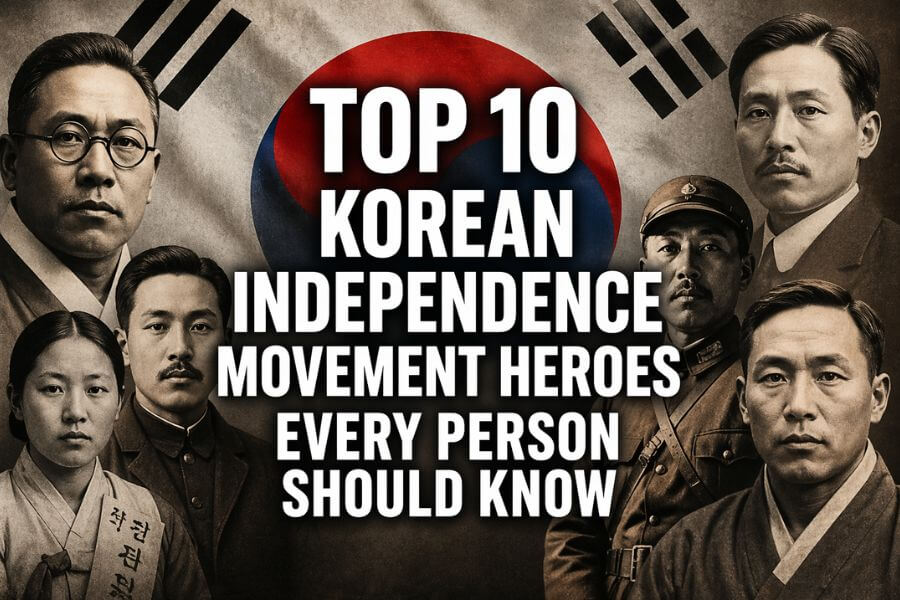
If you want to understand Korea today, you need to know the people who fought for its freedom. During the early 20th century, Korea was under Japanese colonial rule, and many brave individuals risked their lives to fight for independence. Some became symbols of courage, while others worked quietly behind the scenes. In this article, you will discover ten Korean independence movement heroes whose stories still inspire people today. Their sacrifices shaped the nation, and their legacy continues to live on.
1. Kim Gu
Kim Gu is one of the most respected leaders in Korea’s independence movement. As the head of the Provisional Government of the Republic of Korea in exile, he worked tirelessly to unite different groups fighting for freedom. You can see his dedication in how he supported armed resistance and diplomatic efforts at the same time. He believed deeply in education, culture, and national identity, and he wanted Korea to be a strong and moral nation after independence.
2. Ahn Jung-geun
Ahn Jung-geun is famous for his bold act of resistance. In 1909, he assassinated Ito Hirobumi, a key Japanese official responsible for Korea’s colonization. You might see his action as risky, but for many Koreans, it symbolized courage and sacrifice. Ahn believed that his actions would help bring justice and peace to East Asia. His story is often taught as an example of standing up against oppression.
3. Yu Gwan-sun
Yu Gwan-sun is one of the most iconic figures of the March 1st Movement in 1919. As a teenage student, she led peaceful protests demanding independence. Even after being arrested and imprisoned, she continued to speak out against colonial rule. Her bravery at such a young age inspires many people, especially students. You can see her as a symbol of hope and determination.
4. Syngman Rhee
Syngman Rhee played a key role in the diplomatic side of the independence movement. He worked overseas, especially in the United States, to gain international support for Korea’s independence. You might know him as the first president of South Korea, but before that, he was deeply involved in promoting Korea’s cause on the global stage. His efforts helped bring attention to Korea’s struggle.
5. Kim Won-bong
Kim Won-bong was a leader of the Korean independence army and founded the Korean Heroic Corps. This group carried out direct actions against Japanese authorities. If you are interested in the more militant side of the independence movement, his story stands out. He believed that strong action was necessary to fight colonial rule, and he worked closely with other resistance groups.
6. An Chang-ho
An Chang-ho focused on education and community building as a way to prepare Korea for independence. He believed that a strong nation starts with strong people. You can see his influence in how he promoted self-improvement, leadership, and unity. He also worked with Korean communities abroad to support the independence movement.
7. Hong Beom-do
Hong Beom-do was a military leader who played a major role in armed resistance. He led Korean independence forces in battles against Japanese troops, including the famous Battle of Bongo-dong. If you want to understand how Koreans fought back on the battlefield, his story gives you a clear picture. His leadership helped boost morale among resistance fighters.
8. Yun Bong-gil
Yun Bong-gil is remembered for his brave act in Shanghai in 1932, where he carried out a bombing at a Japanese military event. His action gained international attention and showed the world that Koreans were actively resisting colonial rule. You might see him as a symbol of sacrifice and courage, as he gave his life for the cause of independence.
9. Lee Bong-chang
Lee Bong-chang attempted to assassinate the Japanese emperor in Tokyo. Although his mission did not succeed, it sent a strong message about Korea’s resistance. You can understand his determination by looking at the risks he took. His actions inspired other independence activists and showed that the fight for freedom was not limited to Korea itself.
10. Shin Chae-ho
Shin Chae-ho was a historian and writer who used his words as a weapon. He believed that understanding history was key to building national identity. You can see his impact in how he encouraged Koreans to take pride in their past and resist colonial influence. His writings played an important role in shaping the الفكر behind the independence movement.
Conclusion
When you look at these ten heroes, you can see that Korea’s independence movement was not driven by just one type of person. Some fought with weapons, others with words, and others through diplomacy or education. Each of them played a unique role, but they all shared one goal: freedom for their country. By learning about their stories, you gain a deeper understanding of Korea’s history and the sacrifices made for its independence. Their courage reminds you that even in difficult times, individuals can make a powerful difference.
Frequently Asked Questions
What was the Korean independence movement?
The Korean independence movement was a series of efforts by Koreans to end Japanese colonial rule from 1910 to 1945. It included protests, armed resistance, diplomatic work, and cultural movements aimed at restoring Korea’s sovereignty.
Why is the March 1st Movement important?
The March 1st Movement in 1919 was a nationwide protest for independence. It showed strong public support for freedom and gained international attention. It also led to the creation of the Korean Provisional Government.
Were all independence activists involved in fighting?
No, not all activists used violence. Some focused on education, writing, and diplomacy. For example:
- Writers promoted national identity
- Leaders worked to gain global support
- Educators helped prepare future generations
How did the independence movement succeed?
The movement succeeded through a combination of efforts over many years. Internal resistance, international support, and changes after World War II all contributed to Korea gaining independence in 1945.
How are these heroes remembered today?
These heroes are remembered through museums, memorials, textbooks, and national holidays. You can also see their influence in Korean culture, where their stories continue to inspire pride and respect for the nation’s history.