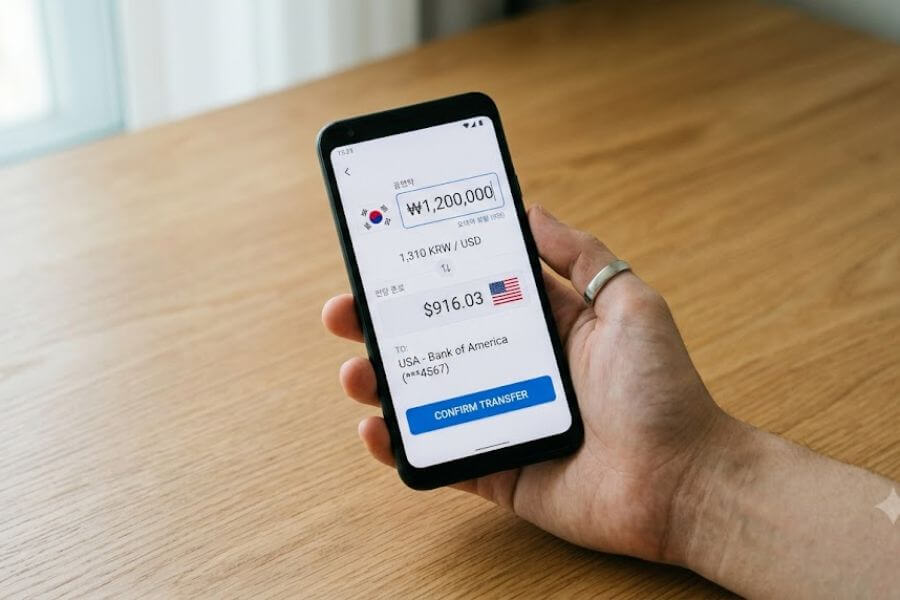
Living thousands of miles away from home comes with massive adventures, incredible food, and a completely different lifestyle. If you are a student, an expat, or an English teacher living in South Korea, you know exactly how exciting this journey can be. Yet, amidst all the fun of exploring Seoul or eating delicious barbecue, real-life responsibilities still follow you. At some point, you will need to send some of your hard-earned Korean Won back home to the United States.
Maybe you need to pay off your American student loans, send a birthday gift to your parents, or simply stack up your savings account in US Dollars. Navigating foreign banks can feel overwhelming when you are staring at a screen full of complicated words. Fortunately, the days of standing in long lines at traditional brick-and-mortar banks are over. Mobile technology has completely transformed this process. This complete guide will walk you through everything you need to know about using smartphone applications to move your money across the world safely and smoothly.
Understanding the Basics of International Money Transfers
Before you tap the download button on any application, you need to understand what happens when money travels between countries. International money transfer is essentially a two-step process. First, an application takes your Korean Won. Second, it converts that money into US Dollars and delivers it to your American bank account.
While this sounds simple, different companies use different methods to make it happen. Knowing these basics helps you protect your cash and ensure it arrives exactly where it needs to go.
The Role of Exchange Rates
The exchange rate is the price of one currency in relation to another. In this case, it tells you how many Korean Won you need to buy a single US Dollar. This number changes every single second because global financial markets never sleep.
When you look at financial news, you see the mid-market rate, which is the real, fair price that global banks use to trade money with each other. Most remittance companies add a small percentage to this rate so they can make a profit. This means you might get fewer dollars than the official market rate suggests. Checking the rate daily helps you spot the best moments to send your funds.
Transfer Fees and Hidden Costs
remittance companies must make money to keep their apps running. They usually charge you in two ways. The first is a flat fee, which is a set amount of money you pay per transfer, regardless of how much cash you send. The second is a percentage fee, which grows larger if you send a bigger amount of money.
The tricky part comes with hidden costs. Some apps claim they charge zero fees, but they give you a terrible exchange rate instead. You must always look at the final amount of US Dollars that will land in your American bank account to see the true cost of your transfer.
Why You Should Pick Mobile Apps Over Traditional Banks
For decades, the only way to move money across borders was to walk into a physical bank branch, fill out a massive paper form, and speak with a teller. Today, smartphone applications have become the preferred choice for younger travelers and expats alike.
Processing Speed
Traditional bank transfers travel through an old global network called SWIFT. This network requires your money to pass through multiple intermediary banks before it reaches the United States. This chain of banks often takes three to five business days to complete the journey.
Mobile applications often bypass this old network entirely. They hold pools of money in different countries, allowing them to complete your transfer in a fraction of the time. Some modern apps can move your money from South Korea to the United States in just a few minutes, while others take less than twenty-four hours.
Convenience and Accessibility
Physical banks in South Korea have very strict operating hours. They typically open at nine in the morning and close their doors by four in the afternoon. If you work a regular job or attend university classes, visiting a bank during these hours is incredibly difficult.
Mobile applications operate twenty-four hours a day, seven days a week. You can initiate a transfer late at night while sitting on your couch, during your lunch break, or even while riding the subway. All you need is a stable internet connection and your smartphone.
Better Communication and Tracking
When you send money through an old-school bank, your funds disappear into a black box for a few days. You are left hoping that everything goes well without any real updates.
Mobile apps fix this problem by giving you live updates. They send push notifications or text messages the moment your money leaves South Korea, when it goes through conversion, and the exact second it lands in your American bank account. This constant communication provides massive peace of mind.
What You Need Before Setting Up Your Account
You cannot simply download an application and start sending thousands of dollars immediately. Governments have strict laws to prevent illegal financial activities, meaning every app must verify your identity. Gathering your documents before you start the registration process will save you a lot of time.
South Korean Identification Documents
To use a Korean remittance application, you must prove that you are living in the country legally. You will need your physical Residence Card, which was previously called the Alien Registration Card.
The application will ask you to take a clear photograph of this card using your phone camera. Make sure you are in a well-lit room and that there is no glare on the plastic surface, as the automated security systems need to read every single letter clearly.
A Local Korean Bank Account
You need a way to fund your transfer. This means you must have an active bank account with a South Korean financial institution.
Your Korean bank account must be fully verified and linked to your legal name exactly as it appears on your Residence Card. If there is even a tiny spelling mistake or if your middle name is missing on one of the documents, the application might reject your registration.
A Korean Phone Number
Every financial application in South Korea relies heavily on phone-based identity verification. You will need a local mobile number that is registered under your exact legal name.
During registration, the app will send a text message containing a short numeric code. You must enter this code within a strict time limit to prove that you own the phone number. If you are using a prepaid SIM card that is not tied to your identity document, you might encounter issues during this step.
Your American Bank Account Information
To complete the link, you must know exactly where the money is going in the United States. You will need to gather your American banking details, which include your full legal name, your bank name, your nine-digit routing number, and your specific account number.
You can easily find these numbers by logging into your American mobile banking app or by looking at the bottom of a physical paper check. Be extra careful when typing these digits into your remittance app, as a single wrong number can cause your funds to bounce back or get lost.
Top Remittance Apps for Sending Money to the USA
Several major applications dominate the market in South Korea. Each app has its own unique strengths, specific fee structures, and processing times. Exploring these options helps you find the one that fits your personal financial habits.
WireBarley
WireBarley is an incredibly popular choice among expats living throughout Asia. It was built specifically to handle cross-border payments with minimal friction.
The application features a clean, simple user interface that supports multiple languages, including English. It allows you to check current exchange rates before you commit to any transaction. WireBarley usually processes transfers within one business day, making it a reliable option for regular monthly expenses like student loans.
Sentbe
Sentbe is another heavyweight in the South Korean remittance space. It focuses heavily on speed and customer service, making it an excellent choice for individuals who want quick results.
Sentbe offers multiple payout options, though direct bank deposit is the most practical choice for sending money to the United States. The app gives you a clear breakdown of costs upfront, ensuring you see the exact exchange rate and any small service fees before hitting the final confirm button.
Hanpass
Hanpass is designed for global citizens who need to move money frequently. It works closely with major international financial networks to ensure high reliability.
The registration process for Hanpass is straightforward, and the app often features promotional periods where they reduce fees for new users. It supports multi-currency wallets, which can be useful if you travel to other countries besides the United States.
GmoneyTrans
GmoneyTrans has built a strong reputation among international workers in South Korea. It offers robust security features and consistent transfer speeds.
This app stands out for its strong customer support team, which can assist you in English if you ever run into a technical glitch. It provides competitive rates and handles your data with the highest level of encryption.
Step-by-Step Guide to Your First App Transfer
Once you have chosen an application and gathered your documents, you are ready to make your first move. Following a precise sequence ensures that your money travels safely without any unnecessary delays.
Step 1: Download and Register
Open the application store on your smartphone and search for your chosen remittance app. Download and install the software, then open it to begin the onboarding process. Select English as your preferred language, enter your local phone number, and verify it using the text-code system.
Step 2: Verify Your Identity
Upload a high-quality photograph of your Residence Card. The app will then ask you to perform a face-verification check, which usually involves looking into your front-facing camera and blinking or turning your head. This proves that you are a real human being and matches your face to your ID card.
Step 3: Link Your Korean Bank Account
Enter your Korean bank account details. To verify that you own this account, the remittance app will usually send a tiny deposit of one Korean Won to your account. You will need to open your regular Korean banking app, check your transaction history, and look at the name of the sender. The sender’s name will contain a three-digit or four-digit code that you must type back into the remittance app to complete the link.
Step 4: Input the Recipient Details
Add a new recipient and choose the United States as the destination country. Carefully type in your American routing number and account number. Double-check that your name matches the name on your American bank account exactly. Save this recipient so you do not have to type these numbers again in the future.
Step 5: Enter the Amount and Confirm
Type in the amount of Korean Won you wish to send. The app will instantly calculate the corresponding amount of US Dollars you will receive, along with any applicable fees. Review the summary page with great care. If everything looks correct, tap the confirm button.
Step 6: Fund the Transfer
The app will now pull the money from your linked Korean bank account, or it will give you a temporary virtual account number. If it gives you a virtual account, you must open your Korean banking app and manually transfer the exact amount of Korean Won to that virtual account within a specific time limit, usually one hour. Once the app receives your Won, your transfer will officially begin.
Comparing the Most Popular Options
To help you choose the best tool for your financial situation, look at how these applications match up against each other across different categories.
| Remittance App | Average Speed | Interface Style | Customer Support |
| WireBarley | 1 Business Day | Minimalist and clean | Responsive email and chat |
| Sentbe | Minutes to 1 Day | Modern and energetic | Multilingual phone help |
| Hanpass | 1 to 2 Business Days | Feature-rich | In-app message center |
| GmoneyTrans | 1 to 2 Business Days | Traditional and solid | Branch locations and phone |
Important Rules and Regulations to Keep in Mind
Moving money across international borders involves dealing with financial laws designed to keep the global economy safe. Staying informed about these regulations helps you avoid frozen accounts or legal headaches.
Annual Remittance Limits
South Korea has strict foreign exchange laws to manage the flow of money leaving the country. For foreign residents, there is usually an annual limit on how much money you can send abroad without presenting extensive paperwork to a bank.
Typically, you can send up to fifty thousand US Dollars per year through these applications without needing to declare specific reasons or show employment contracts. If you need to exceed this amount, you will likely have to visit a physical bank branch to register your primary remittance bank and provide proof of income, such as tax documents or pay stubs.
Tax Implications in the United States
Sending money to yourself across different bank accounts is generally not considered taxable income by the Internal Revenue Service in the United States. You already paid taxes on this money in South Korea.
However, if you are sending large sums of money to family members as a gift, or if you are moving massive amounts of capital, you might trigger reporting requirements. Keep detailed records of your earnings in Korea and your transfer receipts just in case you need to clarify things during tax season.
Tips for Getting the Most Out of Your Money
You work hard for your funds, so you should maximize every single cent during the transfer process. A few smart habits can save you significant amounts of cash over the course of a year.
Monitor the Market Trends
Currency values move up and down constantly based on global events, inflation data, and interest rates. Instead of sending money on the exact same calendar day every month, try to track the exchange rate over a week or two.
If you notice that the US Dollar is weakening slightly against the Korean Won, that is often a great moment to lock in your transfer, as your Won will purchase more Dollars. Many apps allow you to set up rate alerts, which send a notification to your phone when the rate reaches a favorable number.
Send Larger Amounts Less Frequently
If your chosen application charges a flat fee per transaction, sending money frequently in small amounts will drain your funds through repeated service charges.
For example, sending four small transfers of one hundred dollars each means paying that flat fee four times. If you save up your money and send a single transfer of four hundred dollars, you only pay the fee once. This simple change keeps more money in your pocket.
Watch Out for Weekend Rates
Global currency markets close down on Friday evening and open back up on Monday morning. Because rates are frozen during the weekend, some remittance apps build in a safety cushion to protect themselves against market changes that might happen before Monday. This means weekend exchange rates are sometimes less favorable than weekday rates. Whenever possible, try to execute your transactions between Monday and Thursday.
Keeping Your Financial Information Secure
Cybersecurity is incredibly important when you are handling financial applications on a mobile device. Protecting your smartphone ensures that your personal information and your money stay safe from digital bad actors.
Use Strong Authentication Methods
Never rely on a simple, predictable password like your birthday or sequential numbers to protect your financial apps. Enable biometric security options such as fingerprint scanning or facial identification if your phone supports them.
Additionally, always activate two-factor authentication. This system requires you to enter a secondary code sent via text message or generated by a security app before any major transaction can be approved, adding a powerful layer of protection.
Avoid Public Wireless Networks
It can be tempting to initiate a money transfer while sitting in a cozy local coffee shop using their free public internet. However, public wireless networks are often unencrypted and highly vulnerable to hackers who can intercept your data.
Always turn off your wireless connection and switch to your mobile cellular data network when logging into your bank accounts or remittance applications. Alternatively, use a trusted Virtual Private Network to encrypt your internet traffic.
Keep Your Smartphone Software Updated
Technology companies constantly patch security vulnerabilities in their systems. If you ignore software updates on your phone or within your remittance applications, you leave digital doors open for potential security breaches.
Turn on automatic updates for your device so you always have the absolute latest security defenses installed.
Troubleshooting Common Transfer Problems
Even with the best technology, you might occasionally encounter a roadblock during the transfer process. Knowing how to handle these situations calmly will help you resolve issues quickly.
My Transfer Is Taking Longer Than Expected
If your money has not arrived within the promised timeframe, do not panic. First, check the calendar to ensure you are not counting weekends or national holidays in both South Korea and the United States, as banking networks slow down during these times.
Next, check your email and app notifications. Remittance companies will often pause a transfer if they need you to confirm a detail or upload a clearer picture of your identification card.
The App Rejected My Linked Bank Account
If you cannot link your Korean bank account, the most common culprit is a mismatch in your personal details. In South Korea, banking systems are incredibly strict about how names are formatted.
If your bank spelled your name with your middle name attached to your first name, but your remittance app has them separated, the automated system will flag it as a mismatch. If this happens, contact the customer support team of the app so they can manually review and verify your documents.
I Typed the Wrong Account Number
This is the most critical mistake you can make. If you catch the error immediately, open the application and look for a cancel button on the transaction details page. If the app has already processed the transfer and sent the money to the United States, canceling it from your end becomes impossible.
Contact customer service immediately. If the wrong account number you typed does not exist at that specific American bank, the funds will eventually bounce back to the app, though this cleanup process can take several weeks. If the account number does exist and belongs to someone else, recovering the funds requires a lengthy legal process through the receiving bank. Always check every single digit twice before confirming.
Summary of the Best Smart Money Habits
- Gather your physical Residence Card, local phone number, and American banking routing details before starting registration.
- Spelling matters immensely, so ensure your name matches exactly across all documents and accounts.
- Track exchange rates throughout the week and set up automated mobile notifications to catch favorable market movements.
- Execute your transactions on weekdays to secure the best possible conversion rates.
- Consolidate your funds to send larger amounts less frequently, avoiding repeated transaction fees.
- Maintain top-tier digital safety by utilizing biometric logins and avoiding unsecured public wireless networks.
Frequently Asked Questions
Can I send money to the United States if I am only in South Korea on a tourist visa?
No, you generally cannot use these specific local remittance applications if you are traveling on a short-term tourist visa. The regulatory frameworks in South Korea require users to have a legal Residence Card and a local bank account to verify their identity. If you are just visiting the country for a brief holiday, you will need to rely on traditional international transfer methods, global wire services, or your home country bank accounts.
Will using these applications affect my credit score in the United States?
Using international money transfer applications has absolutely zero impact on your credit score in the United States. These transactions are simply moving your existing funds from one account to another across borders. They do not involve borrowing money or opening new lines of credit, which are the activities that affect your credit history. However, ensuring your money arrives on time allows you to pay your American bills and student loans promptly, which protects your credit score.
Is there a limit to how many individual transfers I can make each month?
Most applications do not place a strict limit on the total number of individual transfers you can make within a single month. Instead, they focus on the total cumulative volume of money you are moving. As long as the total amount of money stays within your daily, monthly, and annual legal limits, you can split your transfers up however you see fit. Just remember that making too many small transfers can result in paying more flat transaction fees than necessary.
What should I do if I change my Korean phone number after setting up my app account?
If you change your mobile number, you must update your information inside the application immediately. Because these platforms use your phone number as a core identity verification tool, losing access to that number can lock you out of your account. Before you cancel your old phone service, log into the remittance app, navigate to your profile settings, and follow the steps to update your phone details. If you have already lost access to your old number, you will need to reach out to customer service to verify your identity manually.
Can I send money from my Korean account directly to someone else’s American account?
Yes, you can absolutely send funds directly to another person’s bank account in the United States. When you reach the step where you input the recipient information, simply enter their legal name, their specific bank name, their routing number, and their account number instead of your own. The application will process the transfer exactly the same way, making it a great method for paying back friends, buying gifts, or supporting family members back home.