Key Takeaway
Choosing your teaching path in South Korea depends on what you value most for your daily life. The English Program in Korea provides regular daytime hours, a lot of vacation days, and the stability of a public school setting, though you cannot pick your specific location. Private academies offer control over where you live, smaller classes, and a faster hiring process, but they expect longer hours and provide much less time off.
Teaching English in South Korea is one of the most popular ways to live overseas, experience a new culture, and save money. The country has a high demand for native English speakers, and the benefits often include a monthly salary, free housing, and a completion bonus. When you start researching how to make this move, you will quickly see that your choices split into two main paths. You can work for the public school system through a government program, or you can work for a private after-school academy.
Both options give you a legal work visa and a place to live, but your daily life will look completely different depending on which one you select. One path gives you a classic school environment with short teaching blocks and long seasonal breaks. The other path operates like a business, offering varied shifts, smaller groups of students, and positions that open up every month of the year. Understanding these differences before you apply will help you choose the contract that matches your personal and professional goals.
What is the EPIK Program?
The English Program in Korea is a government-sponsored initiative that places native English speakers in public elementary, middle, and high schools across the country. The goal of this program is to improve the English speaking abilities of Korean students and teachers, while also creating a cultural exchange. When you join this program, you become a guest teacher who works under the guidance of the local education office.
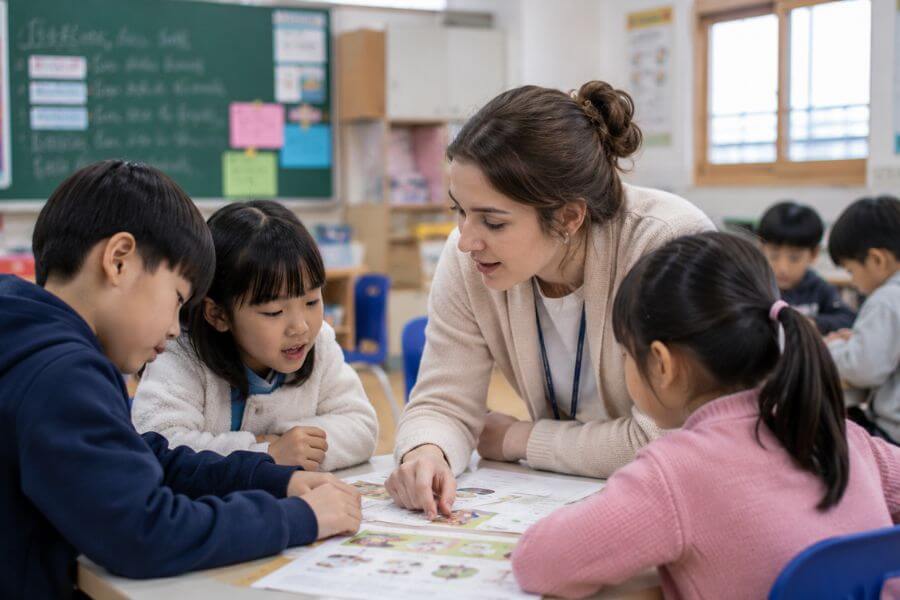
You do not run the classroom by yourself. Instead, you work alongside a Korean co-teacher who helps manage the students and translates instructions when necessary. Your work week follows a standard daytime schedule, usually from nine in the morning until five in the evening, Monday through Friday. You are contracted to teach a specific number of hours per week, while the rest of your time at school is spent preparing lessons in the office.
Because this is a government program, the contract is highly secure and standardized. Every teacher at your experience level receives the same base pay, the same housing allowance, and the same healthcare benefits. The public school calendar also gives you long vacation periods during the summer and winter months when the students are on break.
What is a Hagwon?
A hagwon is a private, for-profit learning academy that students attend after their regular school day ends. These businesses exist because academic success is highly valued in Korean society, and families invest heavily in supplementary education. You can find these academies on almost every street corner in major cities, teaching everything from math and music to English conversation.
Working at a private academy means you are an employee of a business rather than a government entity. Your schedule will depend entirely on the age group of the students who enroll. The most common type of academy operates in the afternoon and evening, catering to elementary and middle school students who arrive after their public school classes finish. Another popular option is an English kindergarten, which runs during the morning and early afternoon.
Because these academies are private businesses, they have a lot of flexibility in how they operate. They hire new staff all year long whenever a position opens up, and they can tell you exactly which neighborhood and building you will work in before you sign your contract. The class sizes are small, which allows you to get to know your students well, but the vacation time is shorter because the academy stays open throughout the year.
Comparing the Application Process and Timeline
The way you secure a position differs greatly between the public and private options. The government program has a rigid, highly structured timeline that requires you to plan many months in advance. Private academies operate on a much faster schedule that can move from your first interview to an official contract in just a few weeks.
Planning for the Government Program
The public school program has two main start dates each year, one in late February for the spring semester and one in late August for the fall semester. The application window opens six months before the start date, and positions are filled on a first-come, first-served basis. This means if you want to start teaching in August, you need to begin preparing your paperwork in February.
The paperwork requirements are strict and require official background checks, university transcripts, and letters of recommendation. You must submit your initial application through the official website or an approved agency, pass an online interview with a coordinator, and then mail your physical documents to Korea for final approval. If you miss a deadline or make an error on your paperwork, your application may be pushed to the next semester.
Applying to Private Academies
Private academies do not follow a single school calendar because they look for teachers throughout the entire year. While their busiest hiring times match the public school terms, positions open up every single month due to contract completions or school expansions. You can look for these jobs through international boards, recruitment agencies, or directly on employment websites.
The interview process is direct and fast. You will speak with the owner or the head instructor of the specific school, and they will often make a hiring decision within a day or two. Once you accept the offer, you still need to collect your visa documents, but the school can apply for your visa sponsorship immediately. This path is ideal if you want to move abroad quickly and do not want to wait for a seasonal intake.
Comparing Your Daily Work Schedule and Hours
Your daily routine, the structure of your day, and the times you are free to explore the country will look very different depending on the school type you choose. Public schools keep you on a traditional daytime routine, while academies often flip your schedule into the afternoon and evening.
The Public School Routine
A typical day at a public school starts around eight-thirty or nine in the morning. You will arrive at the school, check in with your co-teacher, and look over your schedule for the day. You will teach a maximum of twenty-two hours per week, which averages out to about four or five classes per day. Each class lasts between forty and fifty minutes, depending on whether you are at an elementary, middle, or high school.
The rest of your eight-hour workday is dedicated to desk warming, which means you sit at your desk in the shared teachers’ office and work on future lesson plans. When the clock strikes five in the evening, your workday is officially over, and you are free to leave. This schedule gives you consistent evenings to study the local language, exercise, or meet up with friends for dinner.
The Private Academy Routine
If you work at a standard afternoon academy, your day starts much later. You will usually arrive at the school around one in the afternoon to prepare your materials and organize your classroom. The students arrive after two, and you will teach back-to-back classes until nine or ten in the evening. Your teaching load is higher, usually around thirty hours per week, which means you spend more of your day actively standing in front of a class.
If you choose a kindergarten academy, your hours will shift to the morning, running from nine in the morning until five or six in the afternoon. While this matches a daytime routine, the physical demands are high because you are responsible for young children throughout the entire day, often including lunch duty. The benefit of the afternoon shift is that your mornings are completely free to sleep in, visit cafes, or run errands when public spaces are quiet.
Salary, Benefits, and Cost of Living
Both paths offer competitive compensation packages that allow you to live comfortably and save a portion of your income each month. However, the structure of the pay scale and the consistency of the benefits differ between the public and private sectors.
| Benefit Category | Public School Program | Private Learning Academy |
| Starting Base Salary | 2.0 to 2.7 Million KRW | 2.1 to 3.0 Million KRW |
| Location Selection | Assigned by the office | Chosen by the teacher |
| Weekly Teaching Load | Maximum 22 hours | 25 to 30 hours |
| Yearly Paid Vacation | 18 to 26 days | 10 to 11 days |
| Main Shift Times | 9:00 AM to 5:00 PM | 1:00 PM to 9:00 PM |
Understanding the Pay Structures
The public school system operates on a fixed pay scale based on your qualifications and experience. A teacher with a basic degree and a teaching certificate will start at a set tier, and your salary will only increase if you have a higher degree, a teaching license, or years of documented experience within the program. The base pay is stable, and you receive an extra allowance if you are placed in a rural area or if you manage multiple schools.
Private academies offer a wider range of salaries and are often willing to negotiate. Because they are businesses competing for talent, they may offer a higher starting salary to attract candidates, especially in major cities. If you have a strong background or a great interview performance, you can secure a higher rate from the start. However, you must look closely at the required teaching hours to make sure the higher salary justifies the workload.
Standard Contract Protections
No matter which path you select, Korean labor law requires your employer to provide specific benefits if you hold a valid work visa. Both public schools and academies must enroll you in the national health insurance plan and pay half of your monthly premium. They must also contribute to the national pension scheme, which you can often withdraw as a lump sum when you return home, depending on your citizenship.
Every legal twelve-month contract must also include a severance payment equal to one full month of salary upon the successful completion of your contract. Free housing is standard for both options, usually consisting of a furnished single studio apartment near your workplace. While the public school system handles these benefits through an official government office, you must double-check that your private academy contract lists every one of these protections before signing.
Location Preferences and Living Environments
One of the biggest factors in your overall experience is where you live. South Korea has everything from bustling megacities filled with skyscrapers to quiet mountain villages and coastal towns. Your choice of school type will determine how much control you have over your final placement.
The Public School Lottery
When you apply to the government program, you can state a preference for a specific province or metropolitan city on your application form. However, there is no guarantee that you will get your choice. The education offices look at the entire pool of applicants and place teachers where the need is greatest. You will not find out your specific school or neighborhood until you complete your orientation week in Korea.
This means you could end up in a quiet rural community an hour away from the nearest train station, or you could be placed in a smaller city you have never heard of. While rural placements offer a unique opportunity to immerse yourself in the local lifestyle and save money due to lower costs, it can be isolating if you prefer a busy environment. If you are only willing to live in the center of a major city, the public school path can be a gamble.
Picking Your Neighborhood with Academies
Private academies give you total control over your location. When you browse job boards, the listings show the exact city and district where the school is located. If you want to live in a popular neighborhood in Seoul, you can apply exclusively to schools in that specific area. You will know exactly where the school is, what the apartment looks like, and how close you are to public transportation before you accept the job.
This predictability makes it much easier to plan your social life and hobbies. If you have friends living in a certain city, you can focus your job hunt on that specific region to ensure you are close to them. The trade-off is that competition for positions in popular urban centers is fierce, and the living spaces in major cities tend to be smaller than those provided in suburban or rural areas.
Classroom Dynamics and Teaching Responsibilities
The environment inside your classroom will shape your daily energy levels and your job satisfaction. The size of your groups, the materials you use, and your level of independence will shift dramatically between public and private settings.
The Co-Teaching Dynamic in Public Schools
In a public school, your classes will be large, often ranging from twenty to thirty students per room. You are always paired with a local co-teacher, which creates a shared teaching environment. In a best-case scenario, you work as a team where you handle the pronunciation, conversation activities, and cultural lessons, while your co-teacher manages discipline and explains complex grammar points.
However, the reality of co-teaching depends on the personality of your partner. Some co-teachers will want to lead the class while you read vocabulary words aloud, while others will hand the microphone to you and sit at the back of the room. The curriculum is set by the national government, so you will follow a standard textbook and focus heavily on listening and speaking skills rather than preparing students for specialized exams.
Independence in Private Classrooms
Private academies offer a much smaller classroom setting, usually with five to twelve students per session. This small size makes classroom management much easier and allows you to track the progress of every individual student. You are almost always the sole instructor in the room, giving you total independence over how you deliver the material and interact with the children.
While you have autonomy during your teaching blocks, the curriculum is strictly managed by the academy management. These schools use specific textbook series and follow rigid weekly schedules to show measurable results to the parents who pay tuition. You will be responsible for grading homework, writing regular report cards, and sometimes speaking with parents during consultation periods to discuss their child’s academic growth.
Vacation Time and Travel Opportunities
Living in a new country is not just about work; it is also about exploring the region, traveling to nearby countries, and experiencing seasonal holidays. The amount of time you get to spend away from your desk is one of the most significant differences between the two employment paths.
Exploring During Public School Breaks
The vacation package is the primary reason many teachers choose the public school route. A standard contract provides between eighteen and twenty-six paid vacation days per year, in addition to all official national holidays. You are required to take this time off during the summer and winter periods when the school is closed for regular classes.
This structure gives you blocks of one or two weeks off at a time, which is perfect for planning extended trips around Asia or taking a long visit back home to see family. Even during the weeks when students are on break and you are not running active camps, your workload is light, allowing you to rest and recharge before the new semester begins.
Managing Time Off at an Academy
Private academies offer a shorter vacation allowance, typically around ten or eleven paid days per year, plus national holidays. Because these schools run as year-round businesses, they cannot close down for weeks at a time without losing tuition revenue. Your vacation days are usually split into two fixed periods: five days in the heat of summer and five days in the winter.
The exact dates are chosen by the school management to match the quietest weeks of the year, meaning you cannot choose when to take your time off. This layout is fine for short domestic trips to see beaches or mountains, but it makes it harder to plan long international journeys. If your main goal for moving abroad is to travel extensively to other countries, the limited time off at an academy can feel restrictive.
Workplace Culture and Professional Relationships
Every workplace has its own unwritten rules, communication style, and expectations. Adapting to the professional culture in Korea is an important part of your transition, and the environment changes depending on the funding structure of the school.
Navigating Public School Hierarchies
Public schools operate under a traditional, government-style hierarchy. There is a clear chain of command running from the principal and vice-principal down to the head of the English department and your co-teacher. Communication is often formal, and major decisions regarding your schedule or duties must go through multiple layers of approval.
As a foreign guest teacher, you are respected, but you are also outside the core social loop of the school staff because of language barriers. You will experience school dinners where the entire staff goes out for a meal together, which is an excellent way to experience traditional dining customs. The pace of work is generally steady, and there is minimal pressure to market the school or please customers, as the institution is funded by public tax dollars.
The Business Focus of Academies
Private academies have a fast-paced corporate culture. The director of the school is a business owner who cares about student retention, parent satisfaction, and enrollment numbers. This means your appearance, your energy level in the classroom, and your enthusiasm are monitored to ensure parents feel they are getting value for their money.
The positive side of this environment is that the staff is usually younger, smaller, and more cohesive. You will work closely with other foreign instructors and bilingual staff who understand the challenges of moving to a new country. Problems can be solved quickly because you can speak directly with the owner without waiting for a bureaucratic process. However, if enrollment drops or if a parent complains about your teaching style, you will feel the pressure to adjust your approach immediately.
Making Your Decision: Which Path is Right for You
To make the best choice, you need to look honestly at your personality, your goals, and your current life situation. Neither path is objectively better than the other; they simply cater to different types of people and priorities.
Choose the Public School Program If:
- You want a traditional work routine with regular daytime hours and free evenings.
- You prioritize having a significant amount of vacation time to travel and rest.
- You prefer a highly stable, government-backed contract with a predictable pay structure.
- You are flexible about where you live and are open to experiencing life in rural or suburban areas.
- You enjoy working as part of a team and do not mind sharing classroom responsibilities with a local partner.
Choose a Private Academy If:
- You want absolute control over the city and neighborhood where you live.
- You need to move abroad quickly and want a fast hiring process that operates year-round.
- You want to work with small groups of students where you can manage the classroom independently.
- You enjoy a dynamic environment and do not mind working late afternoon and evening shifts.
- You want the ability to negotiate your salary based on your unique presentation and skills.
Frequently Asked Questions
Can I choose the exact school or grade level I want to teach in the public school program?
No, you cannot select your specific school or grade level. The application allows you to list a general preference for a province or city, but the local office of education handles all placements based on the needs of the district. You will find out whether you are teaching at an elementary, middle, or high school when you arrive in the country for your initial training week.
Do I need to know how to speak Korean to get a teaching job?
You do not need to know any Korean to secure a teaching position or obtain an employment visa. The primary goal of both public schools and academies is total English immersion, and you are expected to speak only English while you are inside the classroom. However, learning basic reading skills and common phrases before you arrive will help you navigate daily life outside of work.
What happens if I do not get along with my public school co-teacher?
If you experience communication challenges with your co-teacher, the standard approach is to discuss the matter privately and seek a compromise regarding lesson plans and classroom duties. If the difficulties continue and affect your work, you can reach out to your regional coordinator at the office of education. They can act as an outside mediator to help both parties find a solution.
Are private academies safe and stable places to work?
The vast majority of academies are stable businesses that follow national labor regulations and treat their employees well. However, because they are private businesses, their financial health depends on student enrollment. You can protect yourself by researching the school online, reading reviews from past teachers, and asking to speak with a current native English teacher at that location before you sign the contract.
Can I switch from an academy to a public school after my first year?
Yes, many teachers start their journey at a private academy to ensure they get their preferred city placement, then transition to the public school system for their second year to enjoy more vacation time. You will need to complete your twelve-month contract, collect a letter of release if necessary, and submit a completely new application to the government program during the regular application window.